
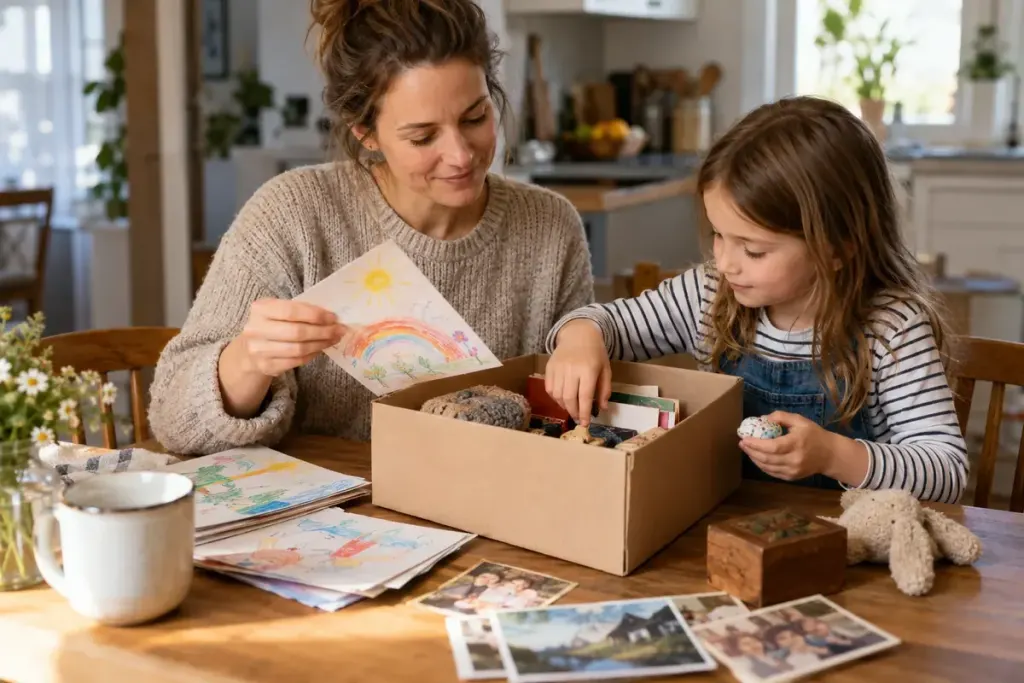
A memory box can become a meaningful collection or simply another container nobody wants to open. The difference often begins with a small keeping rule: choose a few things that help tell a story, rather than treating every piece of paper as equally impossible to let go.
Choose a container that fits the space you actually have. Decide whether it belongs to one child, one year or the family as a whole. That simple boundary makes later decisions easier than adding items indefinitely to an unnamed box.
Let the owner explain the object
A child may value a rough drawing because it remembers a particular afternoon, while an adult prefers the polished school certificate. Ask what the item means before choosing on the child’s behalf. Keep the conversation light; it should not become a test of whether the child remembers the “right” family event.
Add a short note where useful: the date, the occasion or a sentence in the child’s own words. Avoid writing directly on a delicate original if a separate label will do. Context can make an ordinary object understandable years later, when everyone has forgotten why a paper crown mattered.
For bulky items, discuss whether a photograph and a note would preserve the memory sufficiently. Do not secretly discard something after agreeing it would be kept. Respect the child’s ownership and age-appropriate involvement, while explaining the real storage limits.
Keep food, damp materials and items that could damage the collection out of the box. Store it in a suitable dry place and avoid putting private documents where visitors can casually browse them. A memory collection does not need to double as a folder for sensitive records.
Revisit the box occasionally together. Some objects may become more meaningful; others may no longer need to stay. The aim is not a perfect archive or a social-media display. It is a small, usable collection that leaves room for the family’s own explanations and changing choices.