The guest list is finally confirmed.
That should feel like progress. Instead, you open the seating plan and discover a completely different problem.
Your college friends would love sitting together, but one of them knows almost nobody else. Your divorced relatives should probably not share a table. Several guests are bringing partners you have barely met. Your grandparents need somewhere comfortable, while your most energetic friends would happily sit beside the dance floor.
Suddenly, assigning eight or ten names to a table feels strangely complicated.
A good wedding seating chart is not about creating perfect social chemistry between every guest. It is about reducing obvious friction, helping people feel comfortable, and designing a room where conversation can happen naturally.
Start With the Room Before You Start Moving Names
Before deciding who sits together, understand the physical layout.
How many tables will there be? How many guests comfortably fit at each one? Where are the couple, dance floor, speakers, entrances, restrooms, and service areas?
These details affect seating more than people sometimes expect.
An older relative may appreciate being away from loud speakers. Guests with mobility considerations may benefit from easier access. Families with young children may prefer a position that makes leaving the table less disruptive.
The best social arrangement can still fail if the physical placement does not work.
Build Groups Before Building Tables
Do not begin by randomly dragging individual names into seats.
First, identify natural social groups.
You may have immediate family, extended relatives, childhood friends, college friends, coworkers, family friends, and your partner’s equivalent groups.
These are not necessarily the final tables.
They are your starting clusters.
Once you can see how people naturally connect, it becomes easier to identify which groups can be combined and where adjustments are necessary.
Familiarity Matters More Than Perfect Matching
Couples sometimes feel pressure to engineer fascinating conversations between strangers.
Your adventurous friend likes traveling, and your cousin likes traveling, so perhaps they should sit together.
That can work.
But a wedding reception is not a networking event.
Most guests appreciate having at least a few familiar people nearby. Completely separating someone from everyone they know because you think they might enjoy meeting new people can create unnecessary discomfort.
Aim for a balance: enough familiarity to feel relaxed, with enough overlap for new conversations to happen naturally.
Avoid Creating an Obvious “Leftover Table”
This is one of the easiest seating mistakes for guests to notice.
After all the obvious groups have been assigned, several people remain: a coworker, two single friends, a distant cousin, and a plus-one you have never met.
Putting all of them together simply because they did not fit anywhere else can make the table feel accidental.
Instead, look for genuine connection points.
A solo guest might fit naturally with a group they have met before. A coworker with a partner may blend well with friends of a similar age or social energy.
Every table should feel intentional, even if the guests did not all arrive as one group.
Single Guests Do Not Need a Singles Table
Relationship status is not automatically a social connection.
Putting every unmarried guest together can feel forced, especially if they have little else in common.
Some single guests may prefer sitting with close friends who happen to be couples. Others may already know members of another group.
The better question is not, “Who else is single?”
It is, “Where will this person feel comfortable?”
That shift makes a wedding seating chart feel much more human.
Plus-Ones Should Be Treated as Guests, Not Attachments
You may not know every plus-one personally.
They still experience the wedding as an individual guest.
Avoid seating a couple at a table where one person knows everyone and their partner has no realistic way into the conversation.
When possible, place them with a group where the connection is easy to understand and the atmosphere is welcoming.
You do not need to predict whether everyone will become friends.
You simply want to avoid making someone feel as though they have been added to the edge of somebody else’s table.
Divorced or Estranged Relatives Need Practical Distance
Weddings can bring complicated family relationships into one room.
If two relatives have significant tension, seating them together in the hope that everyone will “be mature for one night” creates an unnecessary risk.
They do not always need to be placed at opposite ends of the venue.
Often, separate tables with enough physical and conversational distance are sufficient.
Consider sightlines too. Two tables can technically be separate while still facing each other directly all evening.
The goal is not to dramatize the conflict.
It is to make the room easier for everyone to navigate.
Do Not Use the Reception to Repair Relationships
A seating chart is a poor tool for reconciliation.
If two friends have fallen out, relatives are in conflict, or people have unresolved history, putting them beside each other may not produce the heartwarming reunion you imagine.
More likely, they will spend dinner managing discomfort.
Your wedding does not need to become the setting where every relationship in your social circle gets repaired.
Give people enough space to enjoy the event without forcing a conversation they did not choose.
Think About Conversation Across the Whole Table
A table can look perfect on paper because everyone technically knows someone.
Then you realize the arrangement creates two separate groups who barely interact.
This is where the specific seating order can help.
If you are assigning individual seats rather than only tables, avoid placing all members of one social group together on one side and another group opposite them.
Mixing connections slightly can make conversation flow across the table.
You are not trying to control every interaction. You are simply removing obvious barriers.
Consider Age Without Segregating Everyone by Age
Guests often socialize comfortably with people from different generations.
There is no need to create rigid age zones.
But lifestyle and energy can influence where a table works best.
A group of friends likely to spend most of the evening dancing may enjoy being closer to the dance floor. Older guests who prefer conversation might appreciate a quieter location.
The distinction is less about age itself and more about how guests are likely to experience the reception.
Older Guests May Need a Quieter Table
Music that feels exciting on the dance floor can make conversation difficult several meters away.
If grandparents or other guests are sensitive to loud environments, avoid placing them directly beside speakers or entertainment equipment where possible.
Easy access can matter as well.
A table that requires navigating around equipment, narrow gaps, or crowded areas may be less comfortable for someone with limited mobility.
These practical details can matter more than whether the table has the most impressive view.
Children Change the Seating Equation
There is no universal rule for seating children at weddings.
A dedicated children’s table can work when several children are old enough to eat and socialize independently.
For younger children, sitting with parents or caregivers is often more practical.
The venue setup also matters. Parents may appreciate enough space for a high chair, stroller access, or an easy route away from the table when necessary.
Do not design the children’s seating purely around how cute a separate kids’ table might look.
Design it around supervision and comfort.
The Dance Floor Is Not the Best Seat for Everyone
Tables closest to the dance floor often feel desirable because they are near the action.
But that depends on the guest.
For friends who plan to dance all night, the location can be perfect.
For someone who wants to spend dinner talking, it may be frustrating.
The same principle applies to speakers, bars, doors, and other high-traffic areas.
There is no universally “best table.”
There are tables that work better for particular guests.
Seat People Based on Real Relationships, Not Family Titles
Two cousins may barely know each other.
Two friends from completely different parts of your life may have spent years becoming close.
A seating plan based purely on family labels can miss those realities.
Think about who actually talks when everyone is together.
Who naturally includes other people?
Who already knows whom?
Who would be comfortable joining a different group?
Real social relationships are more useful than formal categories when building tables.
Every Table Benefits From a Social Connector
Some people are naturally good at making a table feel comfortable.
They introduce themselves.
They ask questions.
They include quieter guests.
They can talk to people from different backgrounds without making the interaction feel forced.
You do not need to turn these guests into unofficial hosts, but their presence can help when combining groups that do not know one another well.
One socially generous person can change the atmosphere of an entire table.
Do Not Overengineer Personality
There is a limit to how much social planning helps.
You cannot guarantee that two guests will become friends because they share an interest.
You also cannot predict every conversation.
After eliminating obvious conflicts and creating reasonable groups, allow people to handle the rest themselves.
Guests will move around during the reception anyway. They will visit other tables, go to the bar, dance, and reconnect with people elsewhere in the room.
Dinner seating matters.
It does not determine the entire night.
Table Assignments Are Often Enough
Not every wedding needs assigned individual seats.
For many receptions, assigning guests to tables while allowing them to choose their own seat at that table provides a useful balance.
You still control the broad social arrangement without deciding exactly who sits beside whom.
Formal dinners or specific venue requirements may benefit from assigned seats, particularly when meal selections are tied to individual guests.
The right level of control depends on how the reception operates.
Do not create extra complexity unless it solves a real problem.
Leave Some Flexibility Until RSVPs Are Stable
Building the final seating arrangement too early can create unnecessary work.
One cancellation can affect an entire table.
A late plus-one changes another.
A family update creates another adjustment.
You can begin identifying groups early, but avoid treating the exact arrangement as final while the guest list is still changing significantly.
The closer you get to reliable attendance numbers, the more useful detailed seating becomes.
Do Not Let Table Numbers Become a Ranking
Guests can interpret proximity to the couple as social importance, especially when table numbering appears hierarchical.
You do not need to encourage that interpretation.
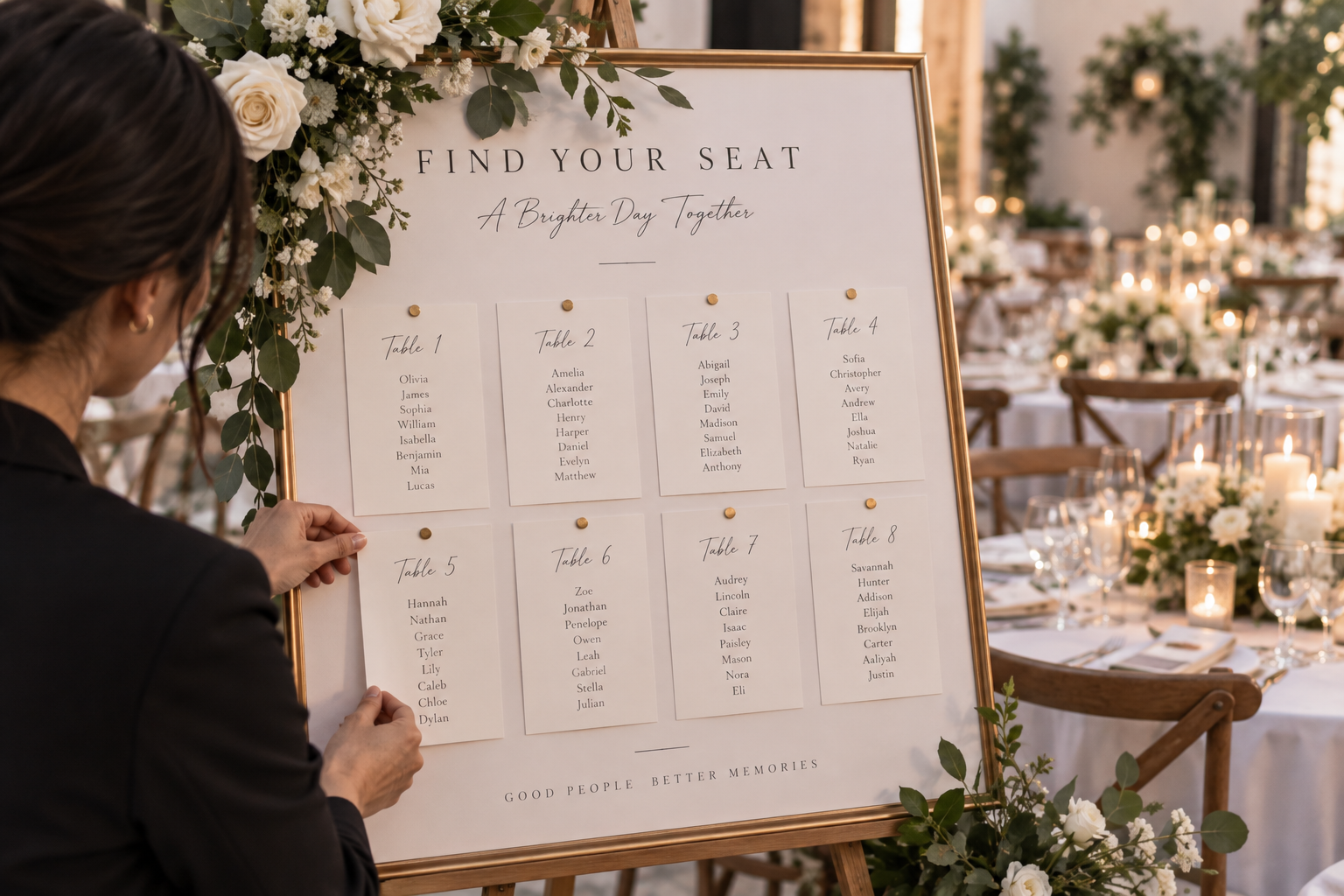
Table numbers are primarily navigation tools.
Depending on the room, Table 2 may not even be meaningfully “better” than Table 8.
Focus on placing guests where the environment works for them rather than trying to create an invisible ranking of relationships.
A thoughtful layout matters more than the number printed on the table card.
Test the Chart From Each Guest’s Perspective
Once the first version is finished, stop looking at it as the couple.
Pick individual guests and mentally experience the table from their perspective.
Who do they know?
Who will they talk to?
Is there anyone they strongly avoid?
Is the physical location comfortable for them?
Would they understand why they were placed with this group?
You do not need every answer to be perfect.
You are looking for arrangements that produce an obvious “Why would you put them there?”
Those are the ones worth reconsidering.
Accept That There May Be No Perfect Arrangement
At some point, moving one person improves one table and creates a new problem at another.
That is normal.
A wedding brings together people from different parts of two lives. There may be no arrangement where every guest sits beside their first choice.
The goal is not mathematical perfection.
It is a room where people have enough connection, comfort, and space to enjoy themselves.
Once those conditions are met, continuing to rearrange names for another five hours may not improve the reception at all.
Conclusion
A wedding seating chart feels difficult because you are not simply arranging names around tables. You are arranging relationships inside a physical room.
Start with natural social groups, then account for real-world considerations: family tension, plus-ones, solo guests, children, accessibility, noise, and how people actually know one another.
Avoid using the seating plan to force friendships, repair conflicts, or separate people according to simplistic categories such as relationship status.
Most importantly, aim for comfort rather than perfection.
Your guests do not need the scientifically ideal dinner companions.
They need a table where they can sit down, recognize a few faces, join the conversation, enjoy the meal—and then get up and celebrate with everyone else.