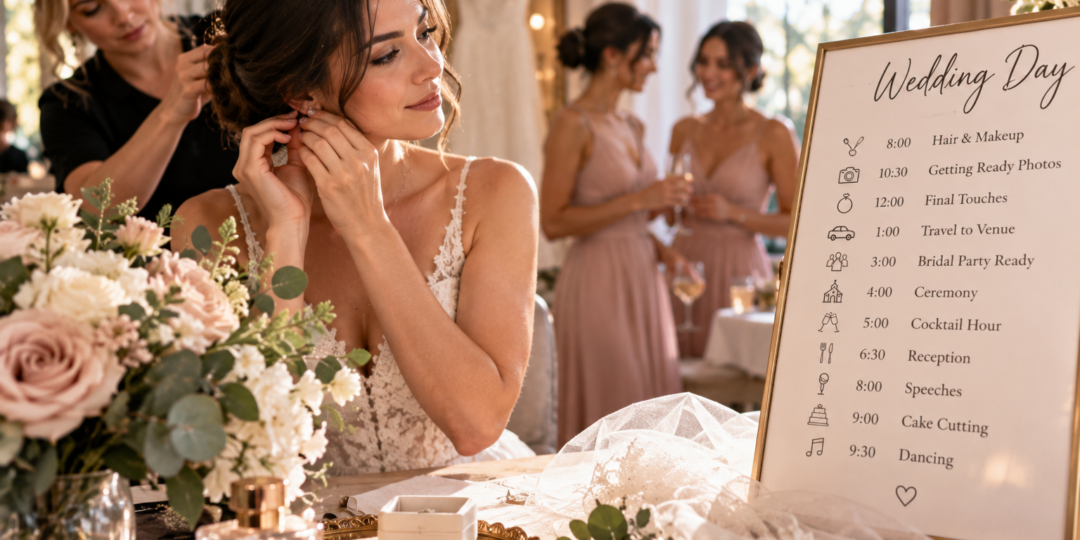
The invitations say the ceremony starts at 4:00 p.m.
Dinner is scheduled for 6:30.
First dance at 7:45.
Cake at 9:00.
Everything is organized.
So why is someone still running through a hotel hallway at 3:47 holding one shoe?
Why is the photographer asking everyone to hurry?
Why hasn’t the wedding party left for the venue?
And why does the couple feel like they’ve spent their entire wedding being told:
“We need to go. Now.”
Usually, the problem isn’t that there was no schedule.
There was.
The problem is that the schedule was built around events, not around everything required to make those events happen.
A realistic wedding day timeline doesn’t simply say when the ceremony begins.
It accounts for getting dressed.
Travel.
Photography.
Guests moving between spaces.
Vendor setup.
Bathroom breaks.
Touch-ups.
Family members disappearing exactly when they’re needed for photos.
And all the tiny transitions that don’t look important on paper but consume real time on the wedding day.
The goal isn’t to control every minute.
It’s almost the opposite.
A good timeline creates enough structure that you don’t have to think about time all day.
A Wedding Timeline Is Not a Minute-by-Minute Prison
This is the first misconception to get rid of.
Some couples hear “timeline” and imagine:
10:02 — put on earrings.
10:04 — drink water.
10:06 — smile emotionally toward window.
10:07 — mother enters room and cries on command.
That’s not planning.
That’s directing a movie.
Real Weddings Need Flexibility
People move at different speeds.
Hair takes longer.
Traffic happens.
A zipper gets stuck.
Someone leaves the bouquet upstairs.
The officiant has a question.
A guest gets lost.
If your entire day collapses because something ran seven minutes late, the timeline was too fragile.
Start With the Fixed Times
Some parts of your wedding are less flexible than others.
These become the anchors.
For example:
ceremony start,
venue access,
catering service,
sunset-dependent photography,
transportation departures,
and venue end time.
Build Around the Anchors
Don’t begin by deciding:
“I want hair at 10.”
Instead ask:
“What must be ready by 3:30?”
Then work backward.
This creates a schedule based on actual dependencies rather than arbitrary times.
Work Backward From the Ceremony
Suppose the ceremony starts at 4:00 p.m.
You don’t want the wedding party arriving at 3:59.
You need to decide when everyone should be:
at the venue,
dressed,
photographed,
and ready to disappear from guest view if that’s part of your plan.
The Ceremony Time Is Not the Arrival Time
That’s a critical distinction.
If guests are arriving 30 minutes before the ceremony, the couple may need to be positioned much earlier depending on the venue and photography plan.
Add a “Ready By” Time
This is much more useful than saying:
“Hair and makeup from 10 to 1.”
Ask:
What time does everyone need to be completely ready?
Not almost ready.
Not makeup finished but still wearing pajamas.
Completely ready.
Clothing on.
Accessories on.
Shoes available.
Bouquets ready.
Personal items packed.
Then Work Backward Again
Now hair and makeup have a real deadline.
Getting Ready Almost Always Contains Hidden Tasks
“Get ready” sounds like one block.
It isn’t.
For one person, it may include:
shower,
hair,
makeup,
breakfast,
getting dressed,
jewelry,
shoes,
touch-ups,
photos,
and gathering belongings.
Multiply that by several people and suddenly the morning is a logistics operation.
Don’t Schedule Hair and Makeup Based Only on the Couple
If multiple people are receiving professional hair or makeup services, the schedule needs to account for:
number of people,
number of artists,
service length,
setup,
and touch-ups.
Ask the Professionals
Your hair and makeup team should be able to estimate how much time their services require.
Use their operational timing rather than guessing from how long your normal morning routine takes.
Wedding styling is not:
“I can do my makeup in 20 minutes.”
Different process.
Different expectations.
Don’t Put the Person Getting Married Last Automatically
It sounds logical:
everyone else gets ready first,
then the person getting married gets the final appointment.
But that can create problems if photography begins immediately afterward.
Build in Breathing Room
Finishing hair and makeup doesn’t necessarily mean you’re ready for photos.
You may still need:
clothing,
accessories,
touch-ups,
bathroom,
food,
and a moment to stop staring at the clock.
Eat Something
This sounds too obvious to deserve its own section.
It deserves its own section.
Wedding mornings get busy.
People forget breakfast.
Lunch disappears.
Suddenly it’s 5 p.m., you’ve had half a strawberry and champagne, and someone hands you another drink.
Put Food Into the Timeline
Not:
“Eat if there’s time.”
Actual time.
You are planning a long, emotionally intense day.
Food is logistics.
Hydration Belongs There Too
You don’t need a hydration spreadsheet.
Just make sure water exists where people are getting ready and that nobody is unintentionally avoiding it because they’re afraid of needing the bathroom in formalwear.
Bathroom Time Is Real Time
Yes.
We are officially including bathroom breaks in wedding planning.
Because reality eventually defeats Pinterest.
Give the Photographer Time for Detail Shots
If you want photographs of:
rings,
invitations,
shoes,
jewelry,
flowers,
or other personal details,
those items should be gathered before the photographer arrives.
Don’t Make the Photographer Search the Hotel Room
Create one box or designated area containing the items you’d like photographed.
Now the photographer can begin immediately.
Decide Whether You’re Doing a First Look
This decision can significantly change the photography timeline.
A first look allows the couple to see each other before the ceremony and may make it possible to complete more portraits earlier.
That Can Reduce Post-Ceremony Photo Pressure
Depending on your preferences and photographer’s plan, you may be able to complete:
couple portraits,
wedding-party photos,
and some family photos
before guests arrive.
But You Don’t Have to Do One
Some couples prefer seeing each other for the first time during the ceremony.
That’s completely valid.
It simply changes where photography fits into the schedule.
No First Look? Protect the Cocktail Hour
If most formal photography happens after the ceremony, calculate realistically how much can be completed during that period.
Family Photos Take Longer Than They Look
“Just one picture with the family.”
Whose family?
Which combination?
Parents?
Siblings?
Grandparents?
Partners?
Children?
Extended relatives?
Suddenly “one picture” has become 19 arrangements.
Make a Family Photo List Before the Wedding
This is one of the easiest ways to save time.
Give the photographer a concise list of required groupings.
For example:
couple + both parents,
couple + immediate family,
couple + grandparents,
and so on.
Prioritize
Don’t turn the list into every possible permutation of everyone attending.
You can take informal photos throughout the reception.
Formal group portraits are most efficient when the list is intentional.
Tell Family Members When They’re Needed
A photo list doesn’t help if Uncle David has already gone to the bar.
Assign Someone Who Knows the Family
A coordinator, wedding-party member, or trusted relative can help gather people.
Photographers are good at photography.
They may not be good at identifying which of the 120 guests is your mother’s brother.
Travel Time Is More Than Google Maps Time
The map says:
hotel to ceremony: 18 minutes.
So you schedule 20.
That’s dangerous.
You Need Door-to-Door Time
Consider:
waiting for elevators,
loading people,
loading dresses,
getting into vehicles,
parking,
unloading,
walking into the venue,
and organizing everyone after arrival.
An 18-minute drive can easily become a much longer transition.
Traffic Can Be Especially Important for Los Angeles Weddings
For an LA-area wedding, a route that looks short by distance may not be short by time.
Traffic patterns can vary substantially depending on location, day, and time.
Don’t Build a Los Angeles Wedding Around Best-Case Driving Time
Check realistic travel conditions for the relevant day and hour, then include buffer.
If several venues are involved, transportation becomes one of the most important parts of the timeline.
One Venue Makes Timing Easier
Getting ready, ceremony, cocktail hour, and reception all in one location?
That’s operationally convenient.
Every Location Change Adds Complexity
Each additional venue introduces:
transport,
parking,
directions,
loading,
unloading,
and the possibility of someone going to the wrong place.
This doesn’t mean multi-location weddings are bad.
It means their timelines need more breathing room.
Guests Need Transition Time Too
Suppose the ceremony ends at 5:00.
Cocktail hour begins at 5:00 in another area.
Technically perfect.
Except 120 people need to:
stand,
collect belongings,
greet someone,
walk out,
find signs,
use the restroom,
and move to the next space.
Humans Don’t Teleport
Build transitions around how people actually move.
Don’t Forget the Receiving-Line Effect
Even without a formal receiving line, guests may stop the couple after the ceremony.
Congratulations.
Hugs.
Photos.
Conversations.
Five Seconds Becomes Twenty Minutes Surprisingly Fast
If you need to move immediately into portraits, your coordinator may need to help guide that transition.
Otherwise, you’ll naturally want to talk to everyone.
Cocktail Hour Is Doing Important Work
Cocktail hour isn’t simply:
“Guests drink while waiting.”
It can create a buffer between ceremony and reception.
During that time:
photos happen,
rooms transition,
vendors reset,
guests mingle,
and the couple may get a brief moment to breathe.
Don’t Treat It as Dead Time
It’s a functional part of the wedding day.
Decide Whether the Couple Will Attend Cocktail Hour
Some couples want to participate.
Others spend most of it taking photographs.
Neither Choice Is Wrong
But decide in advance.
If attending cocktail hour matters to you, your photography schedule needs to protect some of that time.
Build the Reception Around Service, Not Just Entertainment
Reception timelines often focus on:
entrance,
first dance,
speeches,
cake,
and dancing.
But food service has its own rhythm.
Talk to the Caterer
When can dinner actually begin?
How long will service take?
Buffet?
Plated?
Family style?
Stations?
Each format affects timing differently.
Don’t Schedule Speeches Whenever There Is Technically an Empty Minute
A speech may look like a ten-minute block.
But consider what’s happening around it.
Are servers placing hot meals?
Are plates being cleared?
Are guests still finding seats?
Coordinate With Catering
The smoothest reception timelines allow food service and formal events to support each other rather than compete.
Keep Speeches Realistic
Three speakers at five minutes each?
Fifteen minutes.
Except:
one needs to find the microphone,
one speaks for nine minutes,
people laugh,
people applaud,
someone cries,
and now you’ve used 25 minutes.
Build Realistic Estimates
If timing matters, let speakers know the expected length beforehand.
That’s kinder than having someone signal desperately from across the room halfway through their childhood story.
Don’t Schedule Every Tradition Just Because It Exists
Wedding traditions are options.
Not legal requirements.
You don’t automatically need:
bouquet toss,
garter tradition,
cake cutting,
formal entrance,
parent dances,
multiple speeches,
grand exit,
or anything else simply because you’ve seen it at another wedding.
Every Addition Costs Time
Ask:
Do we actually want this?
If not, remove it.
A shorter timeline filled with things you care about is better than a packed timeline full of obligations.
Your First Dance Doesn’t Need to Happen at One Universal Time
Some couples do it immediately after entering.
Others after dinner.
Some combine it with parent dances.
Think About Flow
What happens immediately before?
What happens immediately after?
Where are guests?
Is the dance floor already accessible?
The timeline should feel like a sequence, not a checklist being executed.
Cake Cutting Can Be Strategically Timed
Cake cutting can signal that dessert service is beginning.
For some weddings, it also occurs around the point when older guests may begin leaving.
Coordinate With the Venue and Caterer
If cake needs to be:
cut,
plated,
and distributed,
the catering team needs to know when that process begins.
Protect the Dance Floor
Here’s a common reception problem.
Dancing starts.
Everyone finally gets onto the floor.
Ten minutes later:
“Please take your seats for another speech.”
Then dancing restarts.
Then stops for cake.
Then restarts.
Then stops again.
Momentum Matters
Once open dancing begins, consider minimizing interruptions.
Group formalities together where possible.
Let the party become a party.
Sunset Photos Need an Actual Sunset Time
If you want golden-hour portraits, don’t schedule them based on:
“around 7-ish.”
Sunset changes throughout the year and depends on location.
Check the Date
Then coordinate the photography plan around the actual light.
Your photographer can advise on the best window.
Golden Hour Is Not a 90-Minute Photo Shoot Requirement
You don’t need to disappear from your reception forever.
Often, a short portrait session can capture beautiful evening light.
Plan the Exit and Return
The photographer should know where you’re going.
The coordinator should know you’re leaving.
The DJ or MC should know not to announce something important while you’re outside.
Coordination prevents chaos.
Build Buffers Before Important Moments
This is one of the most useful rules in the entire article.
Don’t put every buffer at the end of the day.
Put Small Buffers Where Delays Are Likely
After getting ready.
Before leaving for the venue.
Before the ceremony.
Before major reception transitions.
A Buffer Isn’t Wasted Time
If you’re on schedule, it becomes:
rest,
conversation,
touch-up,
photos,
or simply enjoying the day.
If you’re behind?
It saves you.
Don’t Announce Every Buffer as Free Time
If everyone knows:
“We have 20 spare minutes,”
those 20 minutes will immediately disappear.
Keep Some Flexibility Operational
Your coordinator can know the schedule contains breathing room without presenting it as an invitation to start another activity.
Create More Than One Version of the Timeline
Not everyone needs a six-page master schedule.
Couple’s Version
Key moments.
Where to be.
When to be ready.
Wedding Party Version
Arrival.
Getting ready.
Photos.
Ceremony.
Reception responsibilities.
Vendor Version
Setup.
Deliveries.
Ceremony.
Service.
Formalities.
Breakdown.
Family Version
Mostly:
Please be here for photos at this time.
That’s probably enough.
The Master Timeline Should Still Exist
Someone needs the complete picture.
Usually:
wedding planner,
coordinator,
venue coordinator,
or another designated person.
One Person Should Understand the Whole Day
Otherwise every vendor has a different schedule.
Photographer thinks speeches are at 7:30.
Caterer thinks 8:00.
DJ thinks 7:45.
Now the wedding has entered a multiverse.
Share the Final Timeline With Vendors
Your major vendors should receive the relevant final schedule before the wedding.
Ask Them to Flag Problems
Professionals often spot conflicts couples won’t notice.
The photographer may say:
“That isn’t enough time for family portraits.”
The caterer may say:
“We can’t serve dinner immediately after that.”
The DJ may notice two formalities overlap.
Use Their Experience
A timeline should be collaborative.
But Avoid Endless Last-Minute Versions
Wedding Timeline FINAL.pdf
Wedding Timeline FINAL2.pdf
Wedding Timeline ACTUAL FINAL.pdf
Wedding Timeline FINAL USE THIS ONE.pdf
We’ve all seen this movie.
Establish One Source of Truth
Use one final document or planning system.
If something changes, update the master and clearly communicate the revision.
Put Phone Numbers in the Master Timeline
Include relevant contact details for:
coordinator,
venue,
photographer,
transport,
DJ or entertainment,
caterer,
and other essential vendors.
The Couple Shouldn’t Be the Help Desk
If a delivery driver gets lost at 11 a.m., they should not be calling someone who is currently having wedding makeup applied.
Give vendors an operational contact.
Assign Someone to Handle Questions
This may be the planner or coordinator.
If you don’t have one, designate a trusted person.
Their Job Is to Protect the Couple’s Attention
“Where should these flowers go?”
“When does the bus leave?”
“Who has the rings?”
“Can we move this table?”
Those questions need answers.
They don’t all need answers from you.
Build a Rain Plan Before It Rains
Outdoor ceremony?
Outdoor cocktail hour?
Outdoor photos?
You need an alternative.
Decide the Trigger
Who decides to move indoors?
When?
Based on what conditions?
Where does everything go?
Don’t Create the Rain Plan While Looking at Rain
The stressful time to solve logistics is when you’re already behind schedule.
Weather Can Affect More Than Outdoor Ceremonies
Heat.
Cold.
Wind.
Rain.
Humidity.
All can affect:
photos,
guest comfort,
hair,
transport,
and setup.
Seasonal Conditions Belong in Planning
Especially if parts of the day involve substantial outdoor time.
Give Yourself Time Alone
This might be ten minutes.
Maybe fifteen.
But consider creating a small gap after the ceremony or before entering the reception.
Weddings Are Socially Intense
You’ve been surrounded by:
family,
friends,
vendors,
cameras,
and questions
for hours.
A short private moment with your partner can become one of the most memorable parts of the day.
Schedule Nothing for That Moment
No photos if you don’t want them.
No speeches.
No logistics.
Just:
“We’re married.”
That’s enough.
Don’t Spend the Entire Wedding Taking Photos
Photography matters.
You’ll keep the images for decades.
But the wedding is also something you are supposed to experience.
Talk to Your Photographer About Priorities
Which photos matter most?
Which can be candid?
How long will portraits take?
Can some be completed earlier?
Photography Should Document the Wedding
Not consume the entire wedding.
Don’t Schedule Yourself to Greet Every Guest Individually Unless You Actually Have Time
You may want to speak with everyone.
That’s understandable.
But guest count changes the math.
120 Guests × 2 Minutes = 4 Hours
And two minutes is not a long conversation.
Use Natural Opportunities
Table visits.
Cocktail hour.
Dance floor.
Reception mingling.
You don’t necessarily need a formal conversation block for every guest.
Build the Timeline Around Your Priorities
This is where two weddings with identical ceremony times can have completely different schedules.
Couple A cares most about:
photography.
Couple B:
dancing.
Couple C:
food.
Couple D:
spending time with guests.
Give Time to What Matters
If dancing is your priority, don’t let formalities consume two hours of the reception.
If portraits matter deeply, don’t squeeze them into 14 minutes.
Your timeline reveals your priorities whether you realize it or not.
You Don’t Need to Copy a Wedding Timeline From Pinterest
A sample timeline can be helpful.
But it doesn’t know:
your venue,
guest count,
travel distance,
photo priorities,
catering format,
religious traditions,
family dynamics,
or sunset time.
Templates Are Starting Points
Not instructions carved into stone.
A Sample Wedding Day Timeline
Here’s a simple example for a wedding with a 4:00 p.m. ceremony at or near the reception location.
Times are illustrative—not universal:
9:30 a.m. — Hair and makeup begin
11:30 a.m. — Light meal / lunch available
1:00 p.m. — Photographer arrives and photographs details/getting ready
1:30 p.m. — Final hair and makeup / dressing begins
2:00 p.m. — Couple fully dressed
2:15 p.m. — First look
2:30 p.m. — Couple and wedding-party portraits
3:15 p.m. — Immediate-family portraits
3:35 p.m. — Couple hides away / refreshes while guests arrive
4:00 p.m. — Ceremony
4:30 p.m. — Cocktail hour / remaining portraits
5:30 p.m. — Guests invited to reception
5:45 p.m. — Couple entrance / first dance
6:00 p.m. — Dinner begins
7:00 p.m. — Toasts / speeches
7:30 p.m. — Parent dances / formalities
7:45 p.m. — Open dancing
8:15 p.m. — Short sunset portrait window if appropriate for the date
9:00 p.m. — Cake / dessert
9:15 p.m. — Dancing continues
10:45 p.m. — Final song / exit preparation
11:00 p.m. — Event ends
Again:
this is not a universal wedding schedule.
The value is seeing how transitions and buffers fit between the major events.
Why You Shouldn’t Copy Those Exact Times
Maybe your ceremony is religious and lasts 90 minutes.
Maybe yours lasts 15.
Maybe there is no first look.
Maybe you’re having brunch.
Maybe dinner is a buffet.
Maybe your reception ends at midnight.
Maybe you have 40 guests.
Maybe 300.
Your Timeline Must Match Your Wedding
That’s the entire point.
Build Backward and Forward
This is a useful planning method.
From the ceremony:
build backward through getting ready.
Then from the ceremony:
build forward through the reception.
Meet in the Middle
The ceremony becomes the central anchor connecting two logistical systems.
It keeps the schedule easier to understand.
Add 10–15 Minutes More Often Than You Think
Not necessarily to every single activity.
But transitions regularly take longer than expected.
Especially:
loading vehicles,
getting dressed,
family photos,
moving large groups,
and gathering belongings.
If your estimate assumes everyone behaves with military precision, increase it.
Don’t Let the Timeline Become the Main Character
Here’s the irony.
You build a wedding timeline so you can stop thinking about the wedding timeline.
Someone Else Should Watch the Clock
The coordinator.
Planner.
Venue team.
Or another trusted person.
You should not spend your first dance thinking:
“We’re four minutes behind.”
Nobody cares.
Being 10 Minutes Late Doesn’t Mean the Wedding Is Ruined
Some delays are recoverable.
A good coordinator can adjust:
cocktail hour,
photo order,
speech timing,
or other flexible elements.
The Timeline Is a Tool
Not a moral obligation.
Your wedding isn’t failing because dinner began at 6:42 instead of 6:30.
Know Which Delays Actually Matter
Missing sunset?
Potentially important for photography.
Missing a transportation departure?
Important.
Running into venue overtime?
Potentially expensive.
Starting a flexible speech ten minutes later?
Probably manageable.
Prioritize Consequences
Not every line on the schedule has equal weight.
Watch the Venue End Time
This is one deadline that can matter financially and operationally.
Your venue may have a contracted event end time.
Vendors may also have scheduled coverage windows.
Work Backward From the End Too
If the venue ends at 11:
When is the final song?
When does the bar close?
When does the exit happen?
When does breakdown begin?
The wedding doesn’t magically stop at 11:00:00.
There is a closing sequence.
Vendor Breakdown Is Part of the Day
Guests leave.
But someone still needs to:
pack décor,
collect personal items,
remove rentals,
load flowers,
secure gifts,
and handle leftover food or cake according to the venue’s policies.
Decide Who Is Responsible
Don’t discover at midnight that nobody knows who is taking home the card box.
Make a “Take Home” List
Include things like:
marriage documents as applicable,
cards and gifts,
guest book,
personal décor,
cake accessories,
personal belongings,
and anything the venue will not store.
Assign Names
“Someone will grab it” is not an assignment.
“Alex takes the card box” is.
Your Wedding Day Timeline Should Feel Almost Boring on Paper
That’s a compliment.
No impossible transitions.
No dramatic sprint from location to location.
No 37 formalities.
Just enough structure that everything has room to happen.
The Excitement Belongs in the Wedding
Not the logistics.
FAQ
How do you plan a wedding day timeline?
Start with fixed times such as the ceremony, venue access, reception end time, and other non-negotiable events. Work backward through getting ready and photography, then forward through cocktail hour, dinner, speeches, dancing, and the end of the reception. Include realistic transition time and buffers.
How early should the couple be ready before the ceremony?
There is no universal time because photography, travel, first-look plans, and venue logistics differ. Establish a “fully ready” deadline with your photographer, planner, hair and makeup team, and venue rather than scheduling everyone to finish immediately before the ceremony.
How much buffer time should a wedding timeline have?
There is no single amount that fits every wedding. Small buffers around high-risk transitions—such as getting ready, transportation, photography, and guest movement—can make the schedule much more resilient.
Should we do a first look?
A first look is optional. It can allow more portraits to happen before the ceremony and reduce post-ceremony photography pressure, but some couples prefer seeing each other for the first time during the ceremony.
How long should family wedding photos take?
It depends on the number of groupings, family size, location, and photographer. Create a prioritized family-photo list in advance and make sure the people involved know when and where they’re needed.
What should happen during cocktail hour?
Cocktail hour typically gives guests time to mingle while the couple completes photographs, the venue transitions spaces, or vendors prepare for the reception. Some couples also choose to attend part or all of it.
When should wedding speeches happen?
The ideal timing depends on catering and reception flow. Coordinate speeches with the caterer, planner, and DJ or MC so they don’t interfere with food service or repeatedly interrupt dancing.
How detailed should a wedding timeline be?
The master vendor timeline can be detailed, but guests and wedding-party members usually need only the times relevant to them. Avoid forcing the couple to manage an overly complicated minute-by-minute schedule themselves.
Who should manage the wedding timeline on the day?
Ideally a wedding planner, day-of coordinator, venue coordinator, or another clearly designated person. The couple should not need to personally answer every scheduling and vendor question.
What if the wedding runs late?
A well-designed timeline contains flexible areas that can absorb small delays. Your coordinator and vendors can often adjust non-critical portions of the schedule while protecting important deadlines such as venue restrictions, transportation, or time-sensitive photography.
Conclusion
A great wedding day timeline doesn’t guarantee that everything happens at the exact minute printed on the page.
That’s not its job.
Its job is to make the day resilient.
Hair takes 15 minutes longer?
There’s room.
Traffic slows down?
There’s room.
Grandma disappears before family photos because she found someone she hasn’t seen since 1998?
Hopefully, there’s room for that too.
The mistake is planning only the moments people see:
ceremony.
First dance.
Dinner.
Speeches.
Cake.
Those moments are connected by dozens of invisible transitions.
Getting dressed.
Moving people.
Loading cars.
Taking photographs.
Finding family members.
Serving food.
Resetting rooms.
And simply giving two people enough time to experience the fact that they just got married.
Plan those parts too.
Then hand the timeline to someone you trust.
Because when the wedding day finally arrives, you shouldn’t be checking whether you’re seven minutes behind schedule.
You should be too busy having your special day to care.