
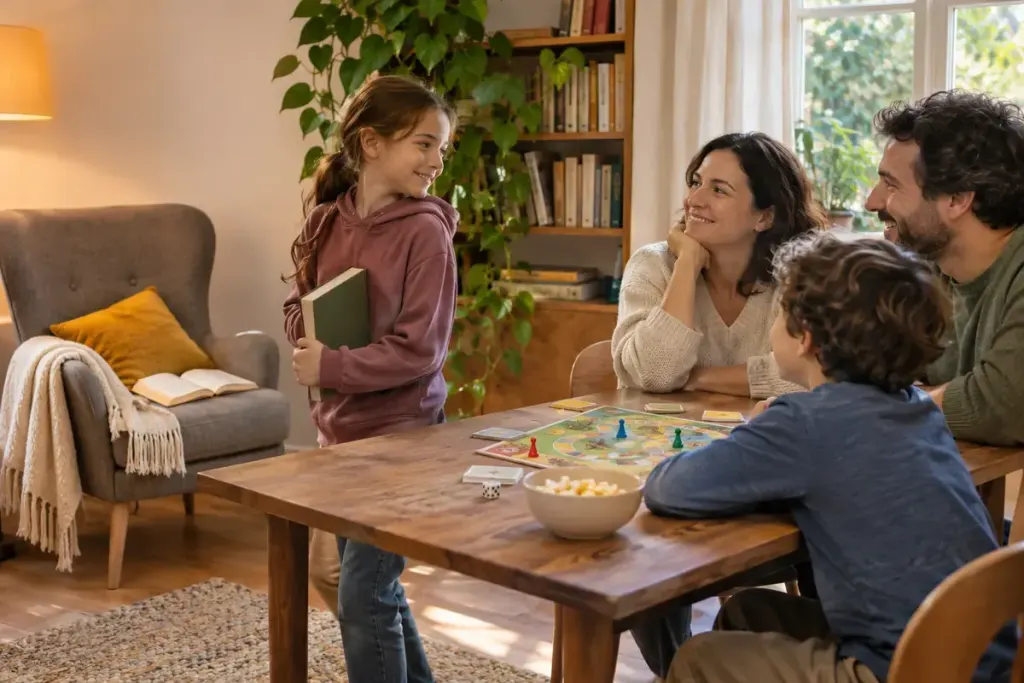
A family game can be enjoyable without requiring every child to stay until the final round. Deciding how someone may leave beforehand can prevent a tired or frustrated moment from becoming the centre of the afternoon.
For an informal gathering, explain the plan simply: people can finish their current turn, tell an adult and choose the nearby quiet activity. Adapt that arrangement to the child’s age and supervision needs. Leaving the game should not mean disappearing from the responsible adult’s care.
Offer an exit that does not require a speech
A child may not have a polished explanation for wanting to stop. Give them a short phrase they can use, such as “I would like a break.” An adult can acknowledge it without asking the whole table to debate whether the reason is good enough.
Set up the alternative before play begins. Drawing materials, a book or another suitable calm activity can provide somewhere to go. Avoid presenting it as a punishment or as a more exciting prize that makes the original game impossible to sustain.
Protect the game without trapping the player
Choose games that can tolerate a person leaving, or agree how their role will be handled. In a team game, an adult might take over the next turn. In a short-round game, the child can leave between rounds. The solution should be proportionate to a casual family activity.
If leaving becomes a repeated flashpoint, discuss it later when nobody is performing in front of the group. Ask whether the game was too long, the rules unclear or the competition uncomfortable. Those answers can guide the next choice without labelling the child as a poor sport.
Adults can model the same courtesy: announce a break, hand over any needed materials and thank the others. The aim is not to remove every moment of disappointment from play. It is to keep participation understandable and respectful, so that joining the next game remains an invitation rather than an obligation.