
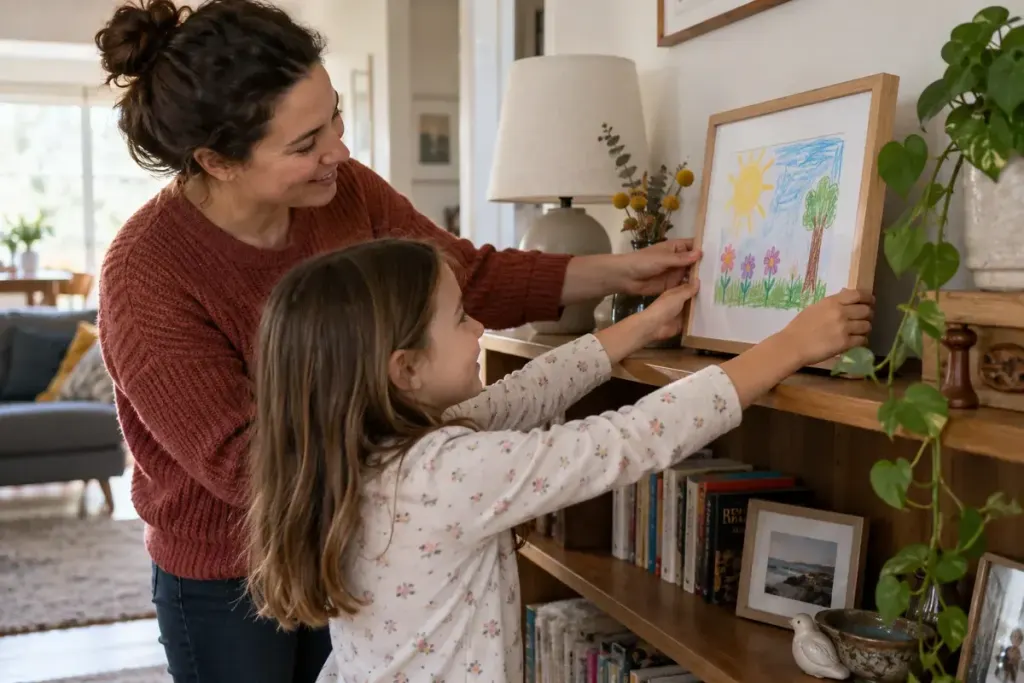
A child brings home a drawing, and an adult immediately announces that it will be shown to every visitor. What was a private moment of pride can become an unexpected performance. Asking first leaves room for the child to decide how the work is shared.
Offer a small number of genuine choices: place it on a shelf, show it personally, let an adult introduce it, or keep it in a folder for now. Avoid offering a choice and then treating one answer as disappointing.
Ask what the child wants people to notice
A finished project may contain a detail that matters more to its maker than the part adults praise first. Ask an open question such as “Which part would you like to tell us about?” Give time for an answer, and accept that the child may prefer not to explain.
For an illustrative family visit, a child might want a model displayed but not want to speak about it at the table. An adult can respect that boundary while still acknowledging the effort involved.
Keep the conversation about the work
Visitors can describe something they notice and ask a manageable question rather than comparing siblings or announcing that the child is the best in the class. Specific interest gives the child something to respond to without requiring them to defend a label.
Do not turn a spelling mistake, unfinished section or unexpected design choice into entertainment for the room. If feedback is needed, choose an appropriate moment and follow the child’s learning context.
Separate showing from publishing
Displaying a project at home is different from sharing a photograph online. Consider names, school details, other children’s work and the child’s preferences before posting. Follow relevant school or family privacy rules.
After the visit, let the child help decide where the work goes next. A rotating display or a personal folder can preserve the experience without making every piece a permanent exhibit.
The invitation is most encouraging when sharing remains something the child can participate in, rather than something arranged around them without warning.