
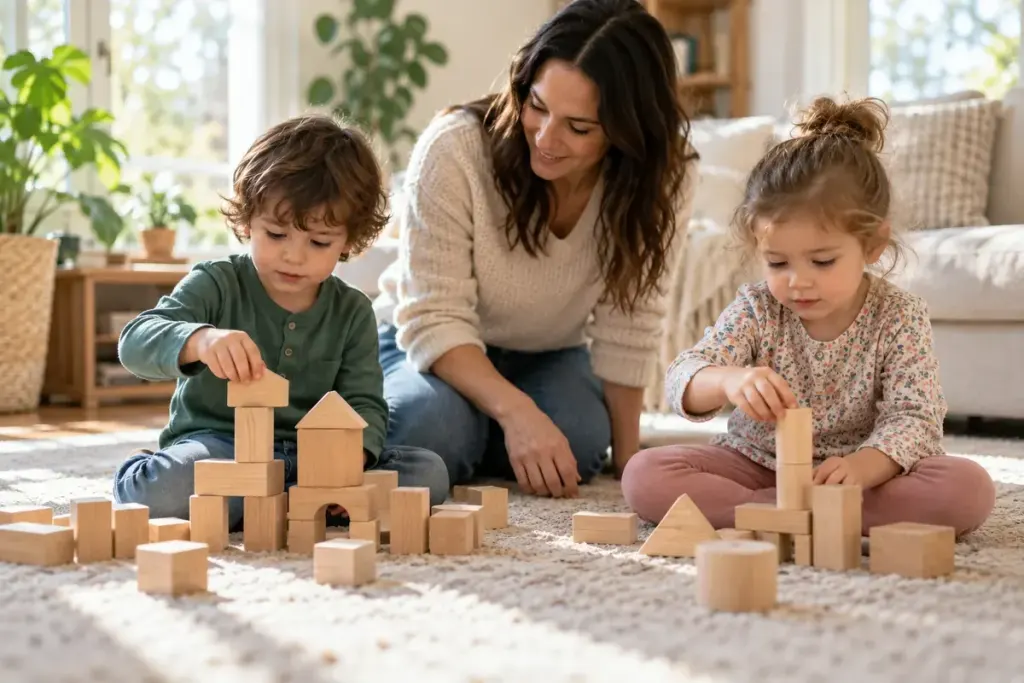
Two children sit beside each other with blocks. One builds a tower while the other arranges a road. They glance across, borrow an idea and return to their own work. They are together without needing to agree on a single game.
ZERO TO THREE’s guide to parallel play describes this proximity and peer awareness without requiring coordinated activity. It also cautions against treating forms of play as rigid developmental deadlines. Children’s play can overlap and change with the situation.
Offer suitable materials with enough space for each child to use them. Similar sets can reduce the immediate pressure to negotiate over one essential piece. Choose items appropriate to the children’s ages and supervise for safety.
You can describe what you notice without demanding collaboration: “You are making a tall tower, and Sam is making a long road.” That acknowledges both activities while leaving the children free to decide whether they connect them.
If one child grabs an object, respond calmly and support a manageable solution. Do not use the situation to insist that successful play always means immediate sharing. A spare item, a supported turn or a change in the arrangement may help, depending on the children and the activity.
Notice brief invitations too—a look, a copied action or an offered block. They can be meaningful without becoming a fully organised joint game. Avoid repeatedly interrupting to ask whether the children are “playing properly together.”
For a family playdate, plan a few simple options and allow children to move between being near, watching and joining in. The adult’s role includes keeping the setting safe and helping with communication, not producing a photograph of perfect cooperation.
If you have concerns about a child’s development, discuss the broader pattern with an appropriate professional. One quiet play session is not enough to label a difficulty. Observing what the child enjoys, communicates and attempts gives that conversation a more useful starting point.