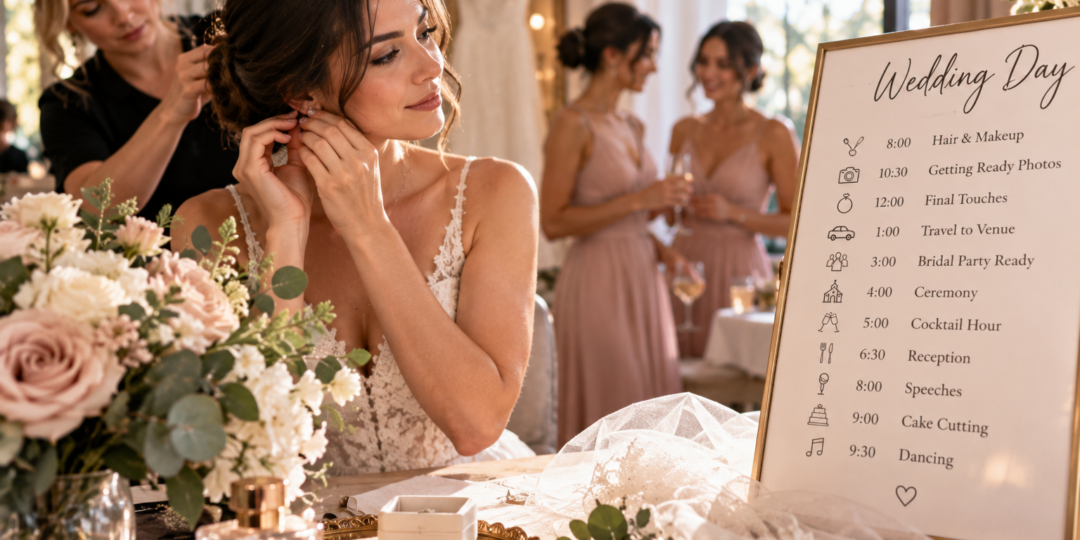
The ceremony is not until late afternoon.
At first, that sounds like plenty of time. Hair and makeup can happen in the morning, everyone gets dressed after lunch, a few photos are taken, and the couple arrives at the ceremony with time to spare.
Then the wedding day actually begins.
One person arrives late. Hair takes longer than expected. A dress needs steaming. Someone cannot find an accessory. The photographer is ready, but half the wedding party is still changing. The car is waiting downstairs while a family member has disappeared to another room.
Suddenly, a 4 PM ceremony feels surprisingly close.
Learning how to create a wedding day timeline is less about filling every minute with an activity and more about understanding how dozens of small tasks depend on one another. A realistic timeline creates enough structure to keep the day moving without making everyone feel as though they are racing a stopwatch.
Start With the Ceremony and Work Backward
The ceremony is usually one of the least flexible points of the wedding day.
Guests have been given a start time. The venue has been prepared. Vendors are working toward it. Transportation, officiants, musicians, and other arrangements may depend on that schedule.
That makes the ceremony a useful anchor.
Instead of beginning with “What time should hair start?” begin with the time everyone must be completely ready to leave for or begin the ceremony.
Then work backward.
Photography needs time before that. Getting dressed happens before photography. Hair and makeup need to finish before dressing or portraits, depending on the plan.
Once those dependencies are visible, the early start makes much more sense.
“Ready at 3 PM” Should Not Mean Finishing at 3 PM
This distinction causes many timeline problems.
If the couple needs to leave at 3 PM, hair and makeup should not be scheduled to finish at exactly 3 PM.
There are still belongings to gather, final bathroom trips, shoes to put on, touch-ups, photos, conversations, and the simple process of getting several people through a doorway.
A deadline should represent the point when the next stage can begin comfortably.
Finishing the previous task at the exact same minute creates no room for normal human delays.
Hair and Makeup Often Control the Morning
Beauty preparation can involve several people and several services.
That makes it one of the first areas where the timeline needs actual math rather than guesswork.
If five people require hair and makeup, the schedule depends on how many artists are working, how long each service takes, whether services happen simultaneously, and who needs to be ready first.
The person required for early photography may need an earlier slot even if another order feels more socially convenient.
Build the schedule around the day’s dependencies, not simply around who wants to sleep the longest.
The Couple Does Not Always Need to Be Last
It can feel logical for the bride or another principal person to receive the final hair and makeup slot so everything looks freshest.
That can create a bottleneck.
If the photographer needs that person for portraits, detail shots, a first look, or wedding-party photos, everyone else may be standing ready while the most important person for the next activity is still in the chair.
Finishing somewhat earlier leaves room for touch-ups later.
Being ready does not mean makeup can never be adjusted again.
Getting Dressed Is an Event, Not a Five-Minute Task
On an ordinary day, changing clothes may take a few minutes.
Wedding clothing can be different.
There may be buttons, hooks, ties, veils, jewelry, cufflinks, complicated shoes, cultural garments, multiple layers, or accessories that need careful placement.
Photography can add more time because the process itself may be documented.
Give dressing its own realistic block.
If the outfit has complicated fastening or styling, practice beforehand rather than discovering the process while the photographer and transportation are waiting.
Steam Clothing Before the Last Minute
A wrinkled dress, suit, veil, or wedding-party outfit is much easier to handle when discovered early.
Waiting until everyone is dressed to notice a problem creates unnecessary pressure.
Build clothing preparation into the morning.
Check garments, accessories, shoes, and anything that needs steaming before the getting-ready room becomes crowded.
This is a small example of a larger principle:
The best wedding timelines solve predictable problems before they become urgent.
Photography Creates Hidden Dependencies
Photography is not simply one block labeled “photos.”
There may be getting-ready photographs, detail shots, portraits, a first look, wedding-party images, family groups, ceremony coverage, cocktail-hour portraits, and reception moments.
Each category requires specific people to be available.
If one parent is missing, a family photo cannot happen.
If a bouquet has not arrived, certain portraits may need to wait.
When building the timeline, identify not only when photography happens but also who and what must be ready for each photo block.
A First Look Changes the Structure of the Day
A first look is not necessary for every wedding, but choosing whether to have one can significantly change the timeline.
Couples who see each other before the ceremony may be able to complete more portraits earlier.
That can include couple portraits, wedding-party photos, and sometimes selected family photographs.
Without a first look, much of that photography may need to happen after the ceremony.
Neither approach is inherently better.
They simply create different scheduling requirements.
Decide early enough that the rest of the day can be built around the choice.
Family Photos Take Longer Than the Photograph Itself
Taking a group photograph may require only seconds.
Assembling the group can take several minutes.
Someone is speaking with a guest. Another person went to the restroom. A relative does not know they are needed. Children have wandered away. One group needs to leave before the next combination can be arranged.
Create a family-photo list before the wedding.
Keep it focused on the combinations that genuinely matter, and make sure key relatives know when they are expected to stay nearby.
Organization saves more time than asking the photographer to work faster.
Travel Time Needs a Buffer
A map may say the ceremony venue is twenty minutes away.
That does not mean leaving twenty minutes before arrival time is a good plan.
Loading people into vehicles takes time. Traffic can change. Parking may be complicated. A shuttle may need multiple stops. Someone may leave something behind.
If the wedding involves multiple locations, treat transportation as a real timeline block.
Include loading and unloading, not only driving.
The clock does not stop while everyone searches for the correct car.
Same-Venue Weddings Still Need Movement Time
Having the ceremony and reception at one property simplifies transportation, but it does not eliminate transitions.
The getting-ready room may be on another floor.
The ceremony garden may be several minutes from the reception space.
Guests need to move.
The wedding party may need to hide from arriving attendees.
Vendors may be resetting spaces between parts of the event.
Walk the venue before finalizing the timeline and understand how people will actually move through it.
A property can look compact on a floor plan while feeling very different in formal clothing.
Vendor Arrival Times Should Connect to the Master Timeline
Different vendors have different setup needs.
The florist may need access before photography. The photographer may need certain details ready on arrival. Entertainment needs setup and sound-check time. Catering follows its own preparation schedule.
The master timeline should help these pieces connect.
That does not mean every vendor needs every minute of the couple’s personal schedule.
Give each professional the information relevant to their role while ensuring the major milestones match across everyone involved.
Conflicting versions of the timeline create confusion quickly.
Build Around Dependencies, Not Just Clock Times
This is one of the most useful ways to understand how to create a wedding day timeline.
Instead of seeing the day as:
10:00 — hair
12:00 — lunch
1:00 — dress
2:00 — photos
Think in dependencies.
The dress cannot be photographed until it is prepared.
Wedding-party portraits cannot happen until everyone involved is dressed.
Transportation cannot leave until the required people are ready.
The ceremony cannot start smoothly if essential participants are still traveling.
Once the dependencies are identified, you can place the appropriate times around them.
This approach exposes unrealistic schedules much earlier.
Buffer Time Should Exist in Several Places
Adding one giant thirty-minute buffer somewhere in the afternoon is less useful than placing smaller cushions around vulnerable transitions.
Hair and makeup may need a little breathing room.
Getting dressed may need some.
Transportation certainly can.
Family photographs may need flexibility.
Buffers do not have to make the day noticeably longer. They prevent a five-minute delay in the morning from becoming a forty-minute delay by the ceremony.
Think of them as shock absorbers for the schedule.
Do Not Fill Every Buffer With Something Else
This is a common mistake.
You intentionally create fifteen free minutes.
Then someone notices the gap and adds another photo idea, an extra stop, a gift exchange, or one more activity.
The buffer disappears.
Leave some empty time genuinely empty.
If everything runs perfectly, those minutes become an opportunity to sit down, drink water, fix makeup, talk to family, or simply experience the day.
If something runs late, the buffer quietly does its job.
Give Important Items One Responsible Person
A surprising amount of time can disappear searching for objects.
Rings.
Marriage documents.
Vows.
Bouquet.
Shoes.
Invitation suite.
Special jewelry.
Emergency kit.
Instead of having everyone assume someone else has them, assign responsibility for important items.
The person carrying the rings should know they are carrying the rings.
Simple ownership reduces last-minute questions.
Eating Needs to Be on the Timeline Too
Wedding mornings can become so busy that people forget basic needs.
Skipping food because the schedule is tight can make an already long day harder.
Plan a realistic opportunity for the couple and wedding party to eat and drink.
Choose food that works with the environment and preparation schedule rather than creating another complicated event.
Lunch does not need to become a formal gathering.
It just needs to actually happen.
Protect the Final Hour Before the Ceremony
The closer you get to the ceremony, the fewer optional tasks should remain.
This is not the ideal time to add another photo location or handle a problem that could have been solved that morning.
The final stretch should focus on arrival, touch-ups, getting participants into position, checking essential items, and allowing everyone to settle.
A calm final twenty minutes feels very different from arriving exactly as guests are taking their seats.
The ceremony deserves some breathing room around it.
Cocktail Hour Is Often a Logistics Window
Guests may see cocktail hour as drinks, conversation, and appetizers.
Behind the scenes, a lot can happen.
Family portraits may continue. The couple may take additional photos. Ceremony spaces may be reset. Reception details receive final checks. Vendors prepare for entrances and dinner service.
When planning cocktail hour, consider what must happen before the couple enters the reception.
If that list is too long for the available window, something needs to move earlier or be simplified.
Reception Timelines Need Breathing Room Too
The reception can easily become overloaded with formal moments.
Entrance.
First dance.
Welcome speech.
Dinner.
Toasts.
Parent dances.
Cake cutting.
Games.
Photos.
Entertainment.
Each item may be meaningful, but placing them too close together can make guests feel as though they are watching a program rather than attending a celebration.
Prioritize the moments that matter most and allow social time between them.
A good timeline guides the evening without making it feel scripted to the minute.
Coordinate Toasts With Catering
Food service and speeches can compete for attention.
A toast beginning while servers are placing hot meals may create noise and movement. Scheduling too many speeches before dinner can leave hungry guests waiting.
Coordinate timing with the catering team and venue.
They understand when service needs uninterrupted movement and when a natural pause exists.
The timeline should support the meal rather than treating catering as something that happens independently in the background.
Sunset Photos Need an Actual Sunset Time
If golden-hour portraits matter to the couple, “sometime before dinner” is not specific enough.
Sunset changes by date and location.
The photographer can help identify a useful window and determine how much time is realistically needed.
Then protect that portion of the schedule.
Trying to create sunset photos after the sun has already disappeared is one of the few timeline problems that cannot be fixed by simply running ten minutes late.
Make One Master Timeline
Different people may need simplified versions, but there should be one authoritative schedule.
If the couple has one timeline, the planner another, the photographer a third, and the wedding party is working from an old screenshot, small discrepancies become large problems.
Finalize the master version and communicate updates clearly.
Include major times, locations, responsible people, transportation, and relevant contact information where appropriate.
The goal is not creating a beautiful document.
The goal is making sure everyone is operating on the same day.
Someone Other Than the Couple Should Watch the Clock
The couple should not spend the wedding checking whether the florist arrived or telling relatives that family photos begin in six minutes.
A planner or coordinator is ideal when available.
For smaller weddings, another clearly designated person may help manage specific logistical responsibilities.
What matters is that ownership is explicit.
If everyone is responsible for keeping the day on schedule, nobody really is.
A Timeline Is a Guide, Not a Punishment
The purpose of a wedding timeline is not to make the day rigid.
It is exactly the opposite.
Structure creates room to relax.
When vendors know when they are needed, transportation has realistic margins, photography has defined windows, and preparation starts early enough, small delays stop feeling like emergencies.
The best timeline may be detailed behind the scenes while feeling almost invisible to guests and the couple.
That is the goal.
Conclusion
Learning how to create a wedding day timeline starts with understanding that the ceremony time is only one point in a much larger chain of events.
Work backward from fixed moments, calculate preparation realistically, give photography and transportation enough time, identify dependencies, and place buffers where delays are most likely. Make sure vendors are working from consistent information and give important responsibilities to specific people.
Most importantly, resist the temptation to fill every minute.
A wedding day needs structure, but it also needs room for people to be people.
Someone will take longer to get dressed. A relative will temporarily disappear. Traffic may move slowly. A photograph may take five minutes longer because everyone is laughing.
A strong timeline does not prevent those moments.
It absorbs them.
And that is why a wedding ceremony beginning at 4 PM may genuinely require the day to start at 8 AM—not because every minute needs to be busy, but because the best wedding days leave enough space that nobody has to spend the final hour running.