
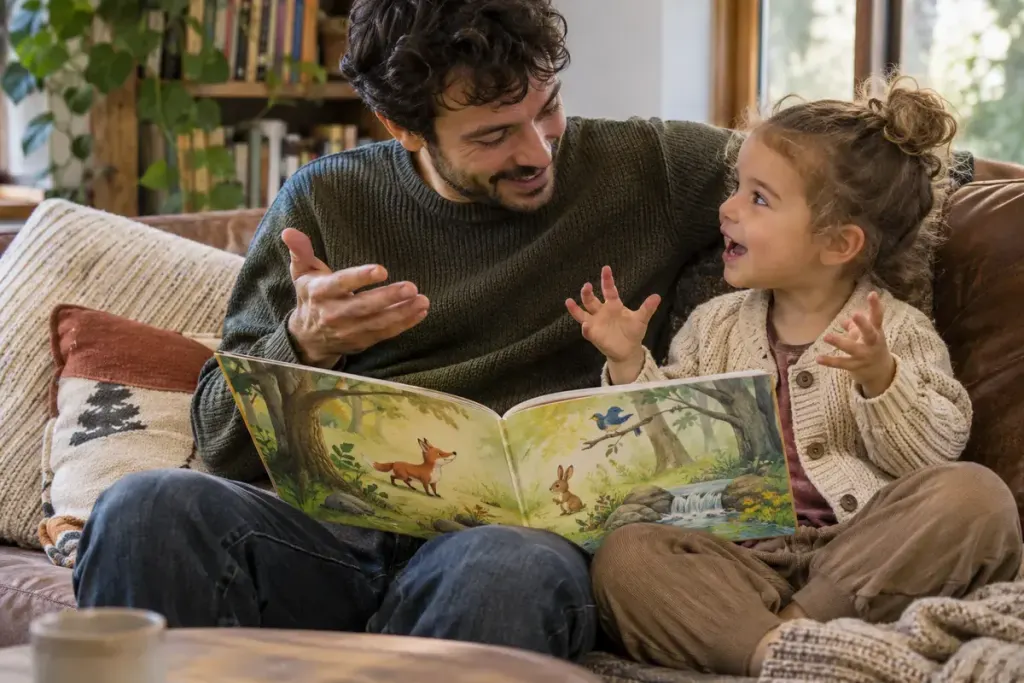
A picture book without printed dialogue can leave an adult wondering what to read aloud. The useful answer is not to invent a perfect script before the child sees the page. Look together and let the story grow from what you notice.
Wordless books give pictures the main storytelling work. Characters, repeated objects, expressions, and changes between pages can suggest events without fixing every sentence the reader must say.
Reading Rockets’ guidance on sharing wordless books encourages discussion of the pictures and the clues used to tell the story. The activity can be a conversation rather than a performance judged against an adult’s hidden answer.
Offer a beginning, then leave space
Try describing one visible detail: “The little boat is beside the door.” Pause. A child might name another detail, suggest who owns it, or turn back to check an earlier picture.
If you offer an interpretation, make its status clear. “I wonder whether she is looking for it” leaves room for a different reading. “She is definitely sad” can close the conversation before the child has described what they see.
For an imaginary scene showing muddy footprints and an empty chair, you could ask which detail might matter on the next page. That connects observation with prediction without requiring a particular vocabulary.
Let the next reading be different
On another day, follow a background character or retell the sequence from a different viewpoint. A child can point, use their preferred language, or contribute a sound instead of a long sentence.
Avoid stopping at every page to ask a question. Sometimes the best response is to listen and turn the page at the child’s pace. If a detail seems inconsistent, look back together rather than immediately correcting the storyteller.
The shared activity is an opportunity to connect images, sequence, and meaning. It does not need a finished transcript. A satisfying reading can end with one remembered detail and an invitation to notice something new next time.