
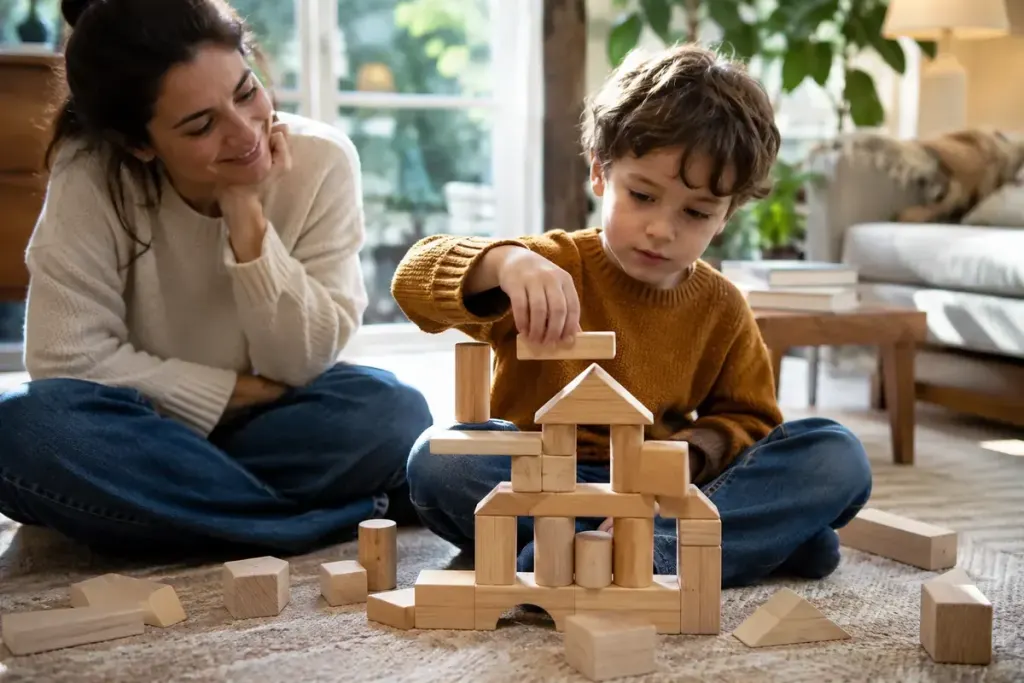
A child stacks two blocks, and an adult immediately asks what colour they are, how many there are and whether a taller tower would be better. The interaction is friendly, but the adult has quietly taken over the activity. Child-led play invites a different response: notice what the child chooses and join without turning every moment into a test.
The CDC’s guide to child-led play recommends age-appropriate, safe materials and attentive participation, with fewer questions, directions and criticisms. Following the child’s lead does not remove the adult’s responsibility for safety.
Replace a quiz with an observation
Imagine the child places a small block beside a larger one. Instead of asking, “What are you building?”, try a simple description: “You put the little block next to the big one.” Leave room for the child to answer, change direction or continue quietly.
If the child gives the blocks a role in an imaginary story, use that role rather than correcting the game into the activity you expected. You can build alongside them with similar materials without making your version the model they must copy.
Make attention specific
The CDC’s guidance on praise, imitation and description explains why specific observations can show that an adult is paying attention. A comment such as “You made space for my block” points to an action more clearly than a constant stream of general approval.
Our suggested reflection after play is short: what did the child choose, when did you feel tempted to direct, and which response left them room to continue? This is a note for the adult, not a scorecard for the child.
Keep boundaries clear if objects are thrown unsafely or someone could be hurt. Choose materials suited to the child’s age and abilities, including avoiding small detachable parts when inappropriate. Within those boundaries, a shared activity does not need an impressive finished product. The useful change is that the child’s decisions become visible in the play, while the adult remains present and responsive.