
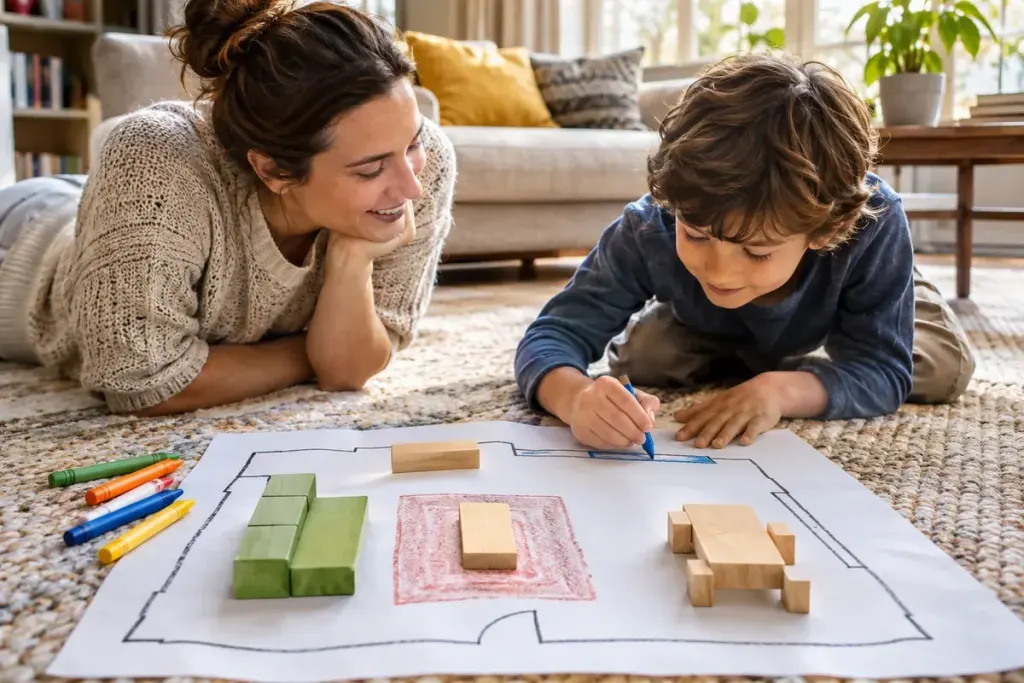
A child knows where the sofa is, but drawing it as though looking down from the ceiling asks a new question about a familiar place. A room map makes that change of viewpoint tangible, especially when the furniture can be represented by movable paper shapes.
National Geographic’s classroom-map resource introduces maps as representations seen from above. Its mapping activity connects the representation with location language. The following home version is a simple adaptation, not a test of a child’s drawing ability.
Build it together
- Choose one room. Start with a small, familiar space and a clear place to sit.
- Mark a doorway. Draw a rough room outline and add the door as an orientation point. Exact scale is unnecessary for this first attempt.
- Add movable furniture. Use large paper rectangles for a table, bed or sofa. Let the child move them while comparing the room with the page.
- Choose a symbol. Agree on a simple mark for one familiar object and explain it in a tiny key.
- Try a route. Trace a path on the map, then walk the corresponding safe route together.
Use large age-appropriate pieces and supervise cutting. Keep the activity away from stairs, hot surfaces and objects the child should not handle.
Let a mismatch become a conversation
If the sofa appears on the wrong side, ask how the map is being held before correcting the drawing. Turning the paper to match the room can make the relationship clearer. “What is beside the door?” invites observation more effectively than “that is wrong”.
Some children may prefer arranging blocks, describing positions aloud or using tactile shapes. The representation can change while the central idea—one place shown another way—remains.
Finish with the child explaining one route or symbol to you. Save the map if they want to revisit it after furniture moves. There is no need to turn it into a polished floor plan or post an identifiable map of your home online. The value is in noticing, representing and explaining a space together.