
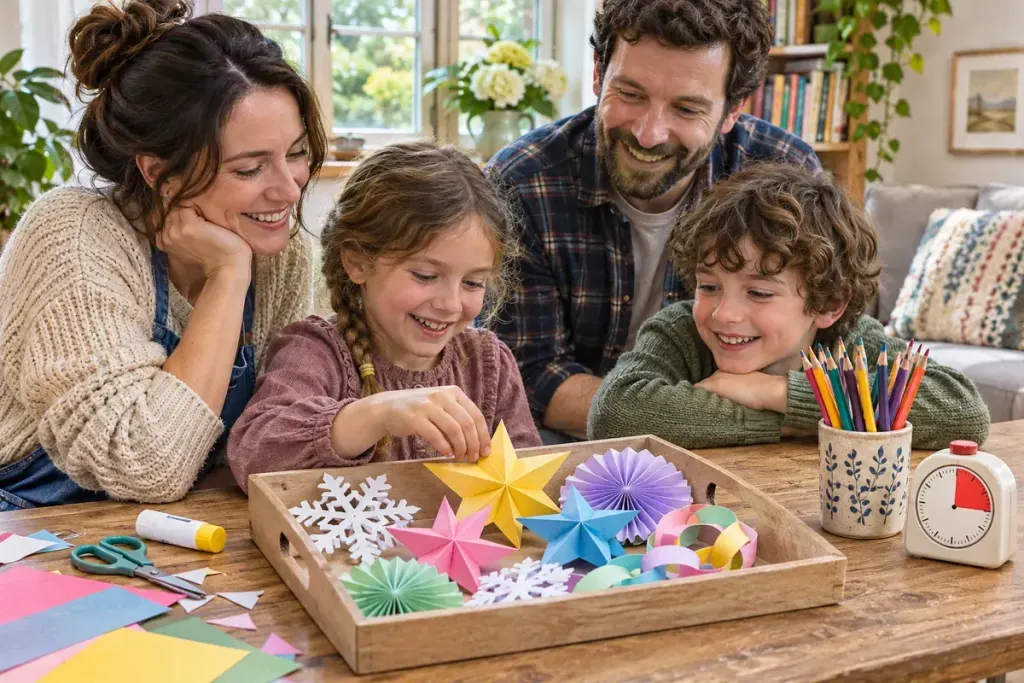
“We will do some painting” explains how an activity starts but leaves its ending uncertain. Does it finish when the page is full, when the timer sounds or when an adult needs the table? A clear ending can help family members understand what they are being invited to do.
The best cue depends on the person. A written plan, a picture, a spoken reminder or a visible collection of materials may be useful. BeyondAutism’s visual-support guidance describes showing progress and completion, including removing a picture when a step is finished. It is an option to adapt, not a method everyone must use.
Choose a finish that belongs to the activity
For a fictional baking afternoon, the family might agree to decorate two biscuits each, place them on a tray and then wash hands. The finish is concrete. It does not depend on guessing what “a little longer” means.
For a story, the ending might be one short book rather than an unspecified amount of reading. For a puzzle, it might be a chosen section, with permission to leave the rest for another day. Ask participants which cue makes sense to them.
Keep an early exit available. A clear plan should support choice, not become a reason to insist that someone continue when tired, uncomfortable or overwhelmed.
Explain a change while it is still a change
If the plan must end sooner, say what is changing and what will happen to unfinished work. A drawing can go in a named folder; a construction can be photographed before it is put away. That is more concrete than promising to return to it “sometime.”
Afterward, ask a simple question: was it easy to know when we were finished? The answer may reveal that the cue was too abstract or that cleanup unexpectedly felt like another activity.
A predictable ending leaves room for enjoyment because fewer details have to be guessed. It also gives the family a small, practical way to improve the next shared activity together.