
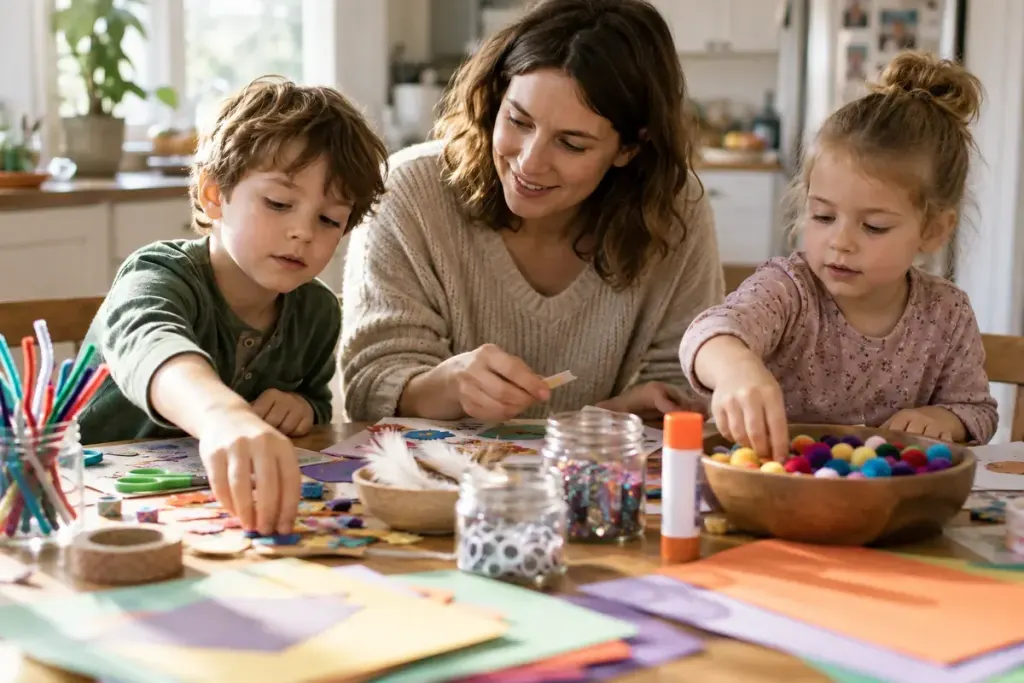
One child wants to make decorations and the other would rather sort the coloured paper. A shared activity does not have to mean identical participation. Inviting each child directly can reveal a workable arrangement before an adult assigns everyone the same task.
Offer a role, not an obligation to enjoy it
Explain what is happening and give a small number of genuine options. One child may cut shapes with appropriate supervision, another may choose colours, and another may prefer to watch before joining. Match materials and supervision to age, ability and individual needs.
Do not ask one sibling to accept an activity solely to keep the other happy. Equally, avoid making a child responsible for persuading or supervising their sibling. Adults remain responsible for the plan and for any support it requires.
Keep the shared part clear
Choose a simple common outcome, such as decorating one table or preparing a family card. Different contributions can lead towards that outcome without a competition over whose work is better. Give each child space for a distinct choice where the activity permits it.
If resources are limited, explain the turn-taking arrangement before the most desirable tool is in someone’s hand. A clear order is easier to discuss calmly than a rule invented after an argument begins.
Allow a manageable exit
Agree how a child can pause or finish their part. Keep any alternative realistic and safe rather than promising unlimited choices. Where a child uses particular communication or support strategies, include those in the plan.
Afterwards, ask each sibling what they liked or would change. Do not measure success only by how long both stayed at the table. A short activity in which each child was heard may provide a better foundation for the next invitation than a long session held together by pressure.
The aim is shared family time with room for individual participation, not proof that siblings must enjoy everything in the same way.