A wedding timeline can look perfectly organized on paper while still creating an uncomfortable experience for guests.
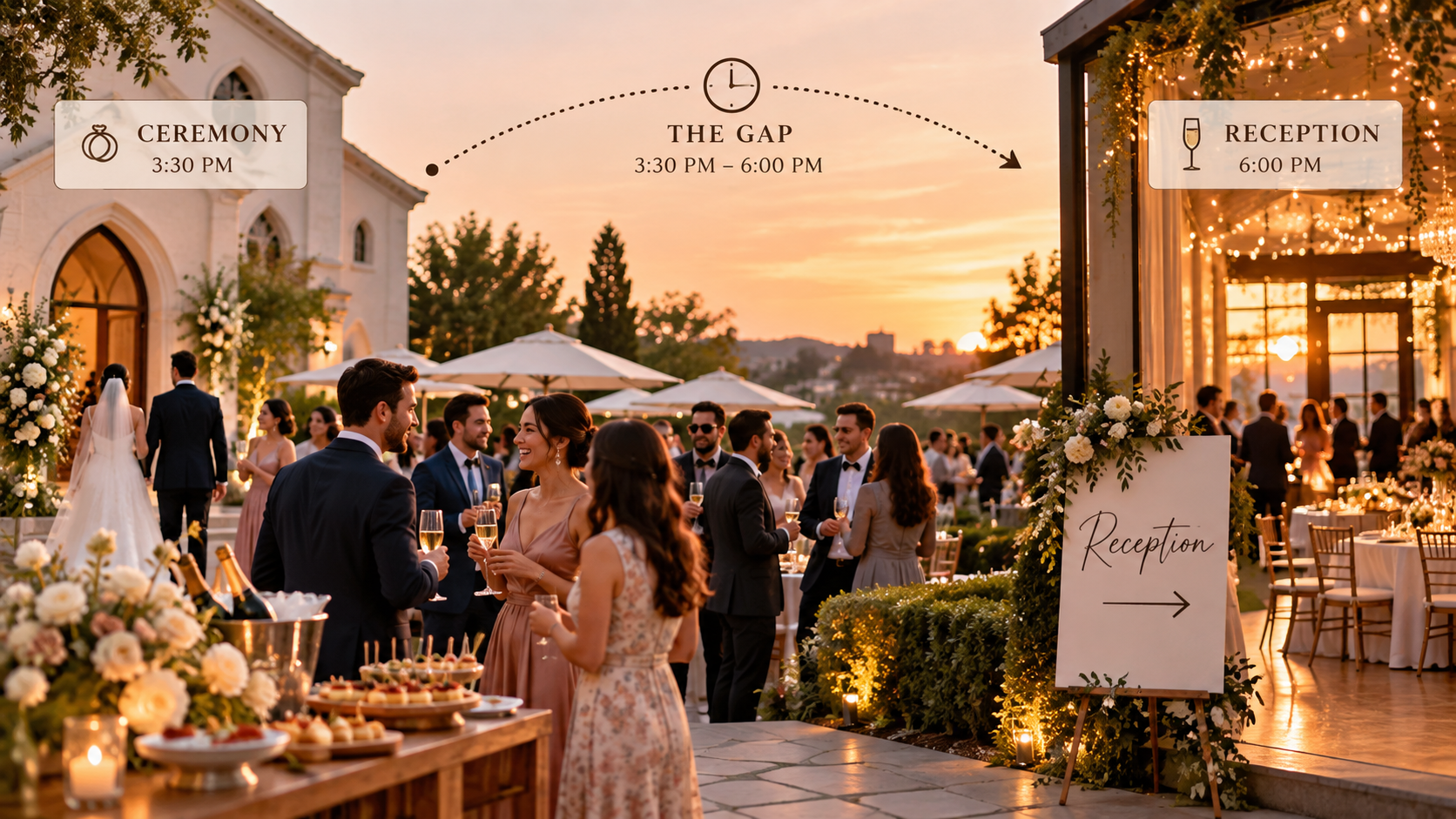
The ceremony ends at 3:30 p.m., but dinner does not begin until 6:00. The couple leaves for portraits, the wedding party has photos to take, and the venue team needs time to prepare the reception space.
For the couple, those two and a half hours may already feel busy.
For the guests, however, the experience can be very different.
They may have nowhere obvious to go, nothing planned to do, and no clear idea of when they should return. Some will sit in their cars. Others will search for a nearby café, return to their hotel, or arrive at the reception venue much earlier than expected.
This wedding ceremony and reception gap is not automatically a planning mistake. In some weddings, a break between events makes perfect sense. However, problems begin when the timeline accounts for what the couple needs during that period but ignores what the guests will experience.
A thoughtful wedding schedule should work for both.
Why a Gap Between the Ceremony and Reception Happens
Ceremonies and receptions do not always fit neatly together.
Perhaps the ceremony takes place at a church with a fixed afternoon time, while the reception venue cannot begin dinner until evening. In other cases, the couple needs time for family portraits, wedding party photos, or travel between locations.
Venue logistics can also create a gap.
If the ceremony and reception use the same space, the team may need time to move chairs, rearrange tables, prepare dinner service, or transform the room.
None of these situations automatically creates a bad wedding experience.
The real question is what happens to the guests while everything else is happening.
The Couple Experiences the Timeline Differently From the Guests
One reason wedding gaps get overlooked is simple: the couple rarely experiences them as gaps.
Immediately after the ceremony, the newlyweds may move from one activity to another.
There are congratulations, family photos, wedding party portraits, couple portraits, wardrobe adjustments, conversations with vendors, and perhaps a private moment before the reception.
Meanwhile, guests may have very little to do.
Therefore, a 90-minute period that feels incredibly short to the couple can feel surprisingly long to everyone else.
When building the timeline, it helps to look at each section from two perspectives.
Ask what the couple will be doing, but also ask where the guests will be.
Not Every Wedding Gap Is a Problem
A short transition between the ceremony and reception can actually improve the flow of the day.
Guests need time to leave their seats, greet one another, find restrooms, move to another area, and settle into the reception.
If cocktails and light refreshments are available, this transition can feel intentional rather than inconvenient.
The problem is usually not the existence of a gap.
Instead, the problem is an unexplained period with no comfortable place to spend it.
A well-designed transition feels like part of the celebration. An unmanaged gap feels like waiting.
How Long Is Too Long?
There is no universal number that works for every wedding.
A 60-minute cocktail hour at the same venue may feel completely natural. On the other hand, a 60-minute gap between two distant venues can feel rushed once parking and travel are included.
Context matters more than the raw number.
Consider the location, transportation, weather, guest demographics, venue access, and available activities.
A longer break can work when guests have a clear plan.
A shorter one can still become frustrating when nobody knows what they are supposed to do.
Travel Time Is Not the Same as Free Time
Suppose the ceremony ends at 4:00 p.m. and the reception begins at 5:30.
At first glance, that looks like a 90-minute gap.
However, the reception venue is 30 minutes away.
Guests need time to leave the ceremony, reach their cars, drive to the next venue, park, and walk inside.
Suddenly, much of the apparent gap disappears.
This is why wedding timelines should use realistic door-to-door travel rather than simply comparing the ceremony end time with the reception start time.
Parking matters too.
A venue may be only 15 minutes away on a map, but downtown traffic, valet lines, unfamiliar roads, or limited parking can change the actual experience.
Avoid Making Guests Guess Where to Go
Uncertainty often makes waiting feel longer.
If guests know that cocktails begin immediately after the ceremony, the transition is straightforward.
However, vague instructions create questions.
Can they enter the reception venue yet?
Should they go somewhere else first?
Will food be available?
Is there assigned seating?
What time do they actually need to return?
Clear communication reduces this friction.
Guests should understand the basic sequence before they have to make decisions on the day.
Cocktail Hour Should Solve a Problem, Not Create Another One
Cocktail hour is the most common way to bridge the transition between ceremony and reception.
When planned well, it gives guests somewhere comfortable to gather while the couple completes portraits or the venue prepares dinner.
However, simply adding the words “cocktail hour” to the timeline does not guarantee a good experience.
Guests still need enough space.
Drinks should be reasonably accessible, and food availability should make sense for the time of day. Seating also deserves attention, particularly when older guests or anyone with mobility needs will attend.
Most importantly, the length should match its purpose.
Stretching a typical cocktail period far beyond what guests expect can turn a pleasant transition into another waiting period.
Food Changes How Guests Experience Waiting
Hunger makes almost every scheduling problem feel worse.
If guests attended an afternoon ceremony and dinner will not begin for several hours, consider what they will have eaten beforehand.
Some may have skipped lunch while getting ready.
Others may have traveled directly from a hotel.
By late afternoon, even a beautiful cocktail space can become uncomfortable if there is very little to eat.
You do not necessarily need to serve a full meal immediately. Still, appetizers or other appropriate refreshments can make the transition feel much more hospitable.
Timing matters just as much as presentation.
Seating Is Easy to Forget
Cocktail-style events often prioritize standing tables and open movement.
That works well for many guests.
Yet not everyone wants or is able to stand for an hour.
Grandparents, pregnant guests, people wearing uncomfortable formal shoes, guests with disabilities, and anyone who has already spent significant time traveling may appreciate a place to sit.
Providing seating does not ruin the social atmosphere.
Instead, it gives people options.
Comfort is part of guest experience.
Weather Can Turn a Reasonable Gap Into a Difficult One
An outdoor transition sounds easy when the forecast is comfortable.
Then the wedding day arrives hotter, colder, windier, or wetter than expected.
Suddenly, guests have nowhere comfortable to wait.
Outdoor cocktail areas need realistic backup plans.
Shade may matter during hot weather, while heaters or an indoor alternative can become important in colder conditions.
Rain plans should also consider more than the ceremony itself.
If guests must walk between buildings or wait outdoors during the transition, those movements deserve protection as well.
A Venue Change Requires More Planning
Holding the ceremony and reception in different locations can create a beautiful wedding day, but it adds logistical layers.
Guests need directions.
They may need transportation.
Parking becomes relevant at both locations.
Traffic introduces uncertainty.
Furthermore, guests unfamiliar with the area may require more time than locals.
When planning the schedule, avoid assuming everyone will move between venues as efficiently as the couple’s vendor team.
Give people enough time to travel without creating an unnecessarily long wait at the other end.
Transportation Can Become Part of the Experience
If many guests are staying at the same hotel or traveling between two difficult locations, organized transportation may simplify the transition.
A shuttle can reduce concerns about parking and navigation.
However, shuttle timing needs careful thought.
Guests should not leave the ceremony only to stand outside waiting for transportation.
Likewise, the first shuttle should not arrive at a locked reception venue.
Coordinate transportation with actual venue access rather than relying only on the formal event times.
Hotel Breaks Sound Easier Than They Are
Couples sometimes assume guests can simply return to their hotels during a long gap.
That can work, particularly when hotels are nearby.
Still, consider the complete process.
Guests drive back, park, walk to their rooms, relax briefly, get ready to leave again, return to the car, and travel to the reception.
A two-hour gap can shrink quickly.
Moreover, some guests may decide that returning to the hotel is not worth the effort.
If a hotel break is the most practical option, provide enough time for it to feel like an actual break rather than another rush.
Nearby Activities Can Help, but Keep Them Optional
For destination weddings or events with a long unavoidable break, couples sometimes suggest cafés, parks, shops, or local attractions.
This can be helpful.
However, avoid creating another mandatory itinerary for guests.
They have already committed time and energy to attending the wedding.
Suggestions should make the day easier, not give everyone another task to complete.
A short list of nearby options can work well when guests genuinely have several free hours.
For a smaller gap, a comfortable organized transition usually makes more sense.
Consider Guests Who Do Not Know Anyone
A long unstructured break feels different when you attend with a large group of friends.
You can decide where to go together and treat the free time as part of the social experience.
A guest attending alone may experience the same period very differently.
They may not know where to go or whom to join.
Therefore, hosted transition spaces become especially valuable when the guest list includes people from different parts of the couple’s lives.
A comfortable environment gives those groups time to connect naturally.
Children Change the Equation
Families with young children often plan their day around meals, naps, transportation, and energy levels.
An unexplained two-hour gap can complicate all of those things.
Parents may need somewhere for children to sit, eat, use the restroom, or simply decompress.
If many families will attend, consider whether the schedule asks children to remain dressed, patient, and entertained for an unrealistic amount of time.
You do not need to design the entire wedding around children.
Nevertheless, acknowledging their needs can prevent avoidable stress for both parents and other guests.
Older Guests May Need a Different Kind of Transition
A beautiful lounge with standing cocktail tables may work perfectly for younger guests.
Older relatives may prefer something else.
Easy access to seating, restrooms, climate control, and minimal walking can make a major difference.
Think about the actual route guests must take.
A short distance across a lawn may not feel short to everyone.
Similarly, repeatedly moving guests from one location to another can become tiring even when each individual transition appears manageable.
Photos Are Important, but They Should Not Control the Entire Guest Experience
Post-ceremony portraits often create the wedding gap.
Couples naturally want photos with family members, the wedding party, and each other.
Those photographs matter.
However, an overly ambitious photo list can consume a large portion of the transition.
Before the wedding, identify which combinations genuinely matter.
Organize family members so they know when they are needed.
Whenever practical, complete some portraits before the ceremony.
Efficient photo planning does not mean rushing the photographer.
Rather, it prevents avoidable confusion from extending the schedule.
Consider a First Look if It Fits Your Priorities
A first look can allow couples to complete some portraits before the ceremony.
For certain weddings, this reduces the amount of photography needed afterward.
As a result, the couple may join cocktail hour sooner or begin the reception earlier.
Still, a first look is a personal choice.
Some couples strongly prefer seeing each other for the first time during the ceremony.
There is no need to change that meaningful moment purely for scheduling convenience.
Instead, understand the trade-off and build the timeline accordingly.
The Reception Room Does Not Need to Be Ready Immediately
If ceremony and reception happen at the same property, guests do not necessarily need immediate access to the final reception room.
A separate cocktail space can create a natural transition.
Meanwhile, the venue team can complete the room setup without guests watching chairs move and tables being adjusted.
This approach can even make the reception reveal feel more intentional.
The key is ensuring that the temporary space feels like a genuine part of the wedding rather than a holding area.
Avoid Too Many Separate Transitions
Every transition costs time.
Guests stand up.
They collect belongings.
They find directions.
They walk or drive somewhere.
Then they settle again.
One or two purposeful transitions may work beautifully.
However, repeatedly moving guests can make the day feel fragmented.
For example, ceremony to outdoor cocktails, cocktails to another building, reception to a separate dinner space, and dinner to another dancing area may sound dynamic on paper.
In practice, the constant movement can interrupt momentum.
Whenever possible, simplify the guest journey.
Build the Timeline Backward From Dinner
Dinner is often one of the strongest anchors in a reception schedule.
Start with the realistic meal service time.
Then work backward.
When should guests enter the reception?
How long will introductions take?
Will there be a welcome speech or first dance beforehand?
How much cocktail time is actually needed?
When should the ceremony end?
Working backward can reveal gaps that are harder to notice when planning from morning to night.
It also helps protect guests from waiting too long for food.
Add Buffer Without Creating Dead Time
Wedding schedules need flexibility.
Without buffer time, one late event can push everything else behind schedule.
However, buffer and dead time are not the same thing.
Useful buffer exists quietly within the schedule.
For example, transportation may include an extra 15 minutes for traffic.
Portraits may receive enough time to avoid rushing.
Venue preparation may finish slightly before guests enter.
Guests do not need to stand around experiencing that buffer directly.
Good planning protects the timeline without making the audience feel the protection.
Do Not Schedule Every Minute for Guests
Solving an awkward gap does not mean filling every moment with entertainment.
Guests usually enjoy time to talk.
They do not need a new activity every ten minutes.
In fact, too many scheduled elements can make the reception feel exhausting.
The goal is simpler: give guests somewhere comfortable to be, something appropriate to eat or drink when necessary, and enough information to understand what happens next.
Socializing can handle much of the rest.
Small Activities Can Support the Atmosphere
If the transition is longer than usual, optional activities can add interest.
A guest book station, lawn games, photo displays, or another simple interactive element may work depending on the wedding style.
However, these details should support the environment rather than compensate for poor scheduling.
No activity completely fixes a three-hour wait without adequate seating, refreshments, or communication.
Handle the fundamentals first.
Then add entertainment if it genuinely fits the celebration.
Music Helps a Transition Feel Intentional
Silence can make a space feel unfinished.
Background music creates atmosphere while guests arrive, talk, and wait for the next part of the celebration.
The music does not need to dominate.
In fact, guests should still be able to have conversations comfortably.
The purpose is to signal that the celebration is continuing.
That small detail can make a transition space feel much more deliberate.
Communication Should Begin Before the Wedding Day
Guests should not discover a major scheduling gap after the ceremony ends.
If there will be a meaningful break, communicate it beforehand.
The invitation details, wedding website, transportation information, or other guest communications can explain the general schedule.
You do not need to publish every behind-the-scenes timing detail.
Simply provide enough information for guests to plan appropriately.
For example, if there is a long break before an evening reception, guests may choose different shoes, arrange transportation differently, or plan where they will spend that time.
Clear Start Times Matter
Avoid giving guests intentionally misleading times in an attempt to make everyone arrive early.
This can create unnecessary waiting.
Instead, communicate accurate arrival expectations and build operational buffer elsewhere.
If the reception space opens at 5:00 p.m., guests should not be encouraged to arrive at 4:15 unless there is somewhere appropriate for them to go.
Trust works better than artificial scheduling tricks.
Think About the Wedding as a Guest Journey
Rather than viewing the wedding as separate events, imagine one guest moving through the entire day.
They arrive at the ceremony.
Where do they park?
How far do they walk?
What happens when the ceremony ends?
Where do they go next?
When can they sit?
When can they eat?
Do they need transportation?
When do they know the reception is beginning?
This perspective often reveals problems that individual vendor timelines miss.
Each vendor may have a perfectly reasonable schedule while the combined guest experience still contains awkward periods.
Test the Timeline With Different Types of Guests
Imagine the day from several perspectives.
First, consider a close friend who knows many people.
Then think about an older relative with limited mobility.
Consider a guest attending alone.
What about parents with a young child?
Finally, imagine someone who has never visited the area.
If the transition works reasonably well for all of them, the timeline is probably in good shape.
You cannot eliminate every inconvenience.
However, you can avoid designing the day around only the easiest possible guest experience.
Ask Vendors About the Gap Early
Your venue coordinator, planner, photographer, caterer, and transportation provider may all influence the ceremony-to-reception transition.
Discuss the timeline before the final weeks.
A photographer can estimate realistic portrait timing.
The venue can explain when spaces become available.
Catering can advise when refreshments and dinner can begin.
Transportation providers can calculate movement between locations.
Bringing those pieces together early prevents one requirement from unexpectedly creating a large guest gap later.
What If a Long Gap Cannot Be Avoided?
Sometimes the schedule cannot change.
A religious ceremony may have a fixed time.
The reception venue may have restrictions.
Travel may be unavoidable.
In that case, stop trying to hide the gap.
Plan around it.
Tell guests what to expect.
Provide realistic transportation information.
Suggest useful nearby options when appropriate.
If possible, arrange a comfortable gathering place.
Most guests can adapt to an unusual schedule when they understand it.
Confusion is often more frustrating than the gap itself.
Keep the Couple’s Experience in Mind Too
Guest comfort matters, but the couple should not spend the entire wedding racing from one obligation to another just to eliminate every minute of waiting.
You deserve enough time for photographs, a private moment, and a reasonable transition into the reception.
Good planning balances both experiences.
The solution is not always making the gap shorter.
Sometimes the better solution is making the guest side of the gap more comfortable.
That distinction can preserve the couple’s priorities without leaving everyone else wondering what to do.
A Smooth Transition Builds Momentum
Weddings have emotional rhythm.
The ceremony creates one of the strongest moments of the day.
Afterward, the energy naturally shifts toward celebration.
A well-planned cocktail period allows that energy to continue.
Guests talk about the ceremony, meet other people, enjoy refreshments, and gradually transition toward dinner and dancing.
An awkward gap can interrupt that momentum.
People scatter.
Some become tired.
Others return late.
Then the reception must rebuild the atmosphere from the beginning.
Maintaining continuity can make the entire wedding feel more cohesive.
Conclusion
A wedding ceremony and reception gap is not automatically a problem.
Many weddings need time between the two events for portraits, transportation, venue preparation, or other logistics.
What matters is how guests experience that time.
If they have clear information, a comfortable place to go, realistic travel time, access to seating, and appropriate refreshments, even a longer transition can feel natural.
However, unexplained waiting creates a very different experience.
When planning the timeline, do not look only at what the couple, photographer, caterer, or venue needs to accomplish.
Follow the guest journey as well.
Ask where people will go after the ceremony, how they will get there, what they will do when they arrive, and how long they will wait before the next meaningful part of the celebration begins.
The best wedding timelines do more than keep events on schedule.
They make the movement between those events feel effortless.