Months of planning eventually become one document.
Hair and makeup.
Getting-ready photos.
First look.
Family portraits.
Guest arrival.
Ceremony.
Cocktail hour.
Dinner.
Speeches.
Cake.
First dance.
Dancing.
Send-off.
Everything has a time beside it.
The wedding day timeline looks organized, detailed, and completely under control.
Then the actual day begins.
Hair and makeup takes fifteen minutes longer than expected. Someone cannot find an accessory. Family members needed for photographs are in different rooms. Guests take longer to move from the ceremony to cocktail hour. Dinner service needs a few extra minutes.
Nothing has gone seriously wrong.
Yet suddenly everyone feels late.
The problem is often not that the wedding lacks a schedule. It is that the schedule was built around how long activities should take while forgetting how much time people need to move, gather, prepare, reset, and transition between them.
A good wedding timeline does more than assign times.
It creates breathing room.
A Wedding Day Timeline Is Not a To-Do List
A checklist tells you what needs to happen.
A timeline explains how those things connect.
That distinction matters.
You might know that family photographs take place after the ceremony and cocktail hour follows immediately afterward.
But several questions remain.
Where will the family gather?
Who tells them to stay?
How long does it take to organize everyone?
Where are the couple’s drinks?
When does the photographer move to the next location?
Who tells guests that the reception space is ready?
The event between two scheduled moments is often where delays begin.
Start With the Fixed Times
Some parts of the wedding are flexible.
Others are not.
The venue may have a firm access time.
The ceremony has a published start.
Catering needs a service window.
Sunset affects photography.
Entertainment may have contracted hours.
The venue may have a hard closing time.
Build the day around these anchors first.
Once the fixed points are clear, flexible activities can be arranged around them instead of forcing everything into arbitrary times.
Work Backward From the Ceremony
The ceremony is usually one of the strongest anchors.
Suppose guests are expected to be seated at 4:30 p.m.
Do not simply decide that preparation ends at 4:00.
Work backward.
When should the couple be completely ready?
When do pre-ceremony photographs end?
When does dressing begin?
How long should hair and makeup realistically take?
When should vendors arrive?
When does the wedding party need to be present?
Working backward exposes timing conflicts before they reach the wedding day.
“Ready at 3:00” Needs a Clear Definition
This phrase causes more confusion than it appears to.
Does “ready” mean hair and makeup are finished?
Or fully dressed?
Does it include accessories?
Shoes?
Jewelry?
Bouquet?
Touch-ups?
Getting-ready photographs?
If the photographer expects the couple to be fully dressed at 3:00 but the beauty team thinks 3:00 is when makeup ends, the schedule already contains a hidden delay.
Define milestones precisely.
Hair and Makeup Need More Than a Finish Time
Beauty preparation often involves several people.
The couple.
Wedding party.
Parents.
Additional family members.
Each service has a duration, and people may rotate between hair and makeup.
Instead of writing:
“Hair and makeup: 9:00–1:00”
create a realistic sequence.
Who starts first?
Who must finish earliest?
Who needs additional styling?
When does the couple begin?
When is the final touch-up?
A detailed internal schedule prevents everyone from assuming they can get ready at the same time.
Do Not Schedule the Couple to Finish Last
It sounds logical.
The couple is the most important part of the preparation, so their styling happens last.
But that can create pressure.
If earlier appointments run late, the delay eventually reaches the person who has the least flexibility.
Finishing with enough margin gives the couple time to dress calmly, eat, take photographs, and handle small surprises without immediately threatening the ceremony start.
Schedule Time to Actually Get Dressed
Wedding attire is not everyday clothing.
Buttons.
Zippers.
Lacing.
Veils.
Jewelry.
Cufflinks.
Shoes.
Boutonnieres.
Final adjustments.
These details take time.
If photographs of the dressing process are planned, they may take longer still.
Do not schedule makeup to finish at 2:55 and expect portraits to begin at 3:00.
Five minutes disappears almost instantly.
Build a Buffer Before Important Moments
Not every activity needs a giant gap.
But important transitions benefit from margin.
Before the ceremony.
Before the reception entrance.
Before transportation departures.
Before sunset portraits.
Before major vendor handoffs.
A buffer does not mean guests stand around waiting.
It means a small delay earlier in the day does not automatically damage everything afterward.
A timeline without buffers assumes perfection.
Real events rarely operate that way.
Avoid Using Every Buffer Before the Ceremony
There is a common mistake.
The schedule starts with generous margins.
Then every delay is allowed to consume them.
By ceremony time, nothing remains.
Buffers work best when they are intentionally protected.
If preparation finishes early, wonderful.
Use that time to breathe.
Do not immediately fill it with another activity just because ten minutes became available.
Photography Needs Movement Time
A photography schedule may say:
Couple portraits: 30 minutes.
Family photos: 20 minutes.
Wedding party: 20 minutes.
Those numbers may be reasonable for the actual photographs.
But people still need to move.
Someone has to find a parent.
The wedding party needs to gather.
The photographer may change locations.
The dress may need adjusting.
Guests may walk through the area.
The couple may need water.
A thirty-minute photo block rarely means thirty uninterrupted minutes of taking pictures.
Family Photos Need a List
Family portraits can quietly consume a large portion of the schedule.
One person leaves.
Another cannot be found.
Someone asks for an additional combination.
Then another relative wants one too.
Prepare the essential combinations beforehand.
Share them with the photographer.
Even better, designate someone who knows the family and can help gather the next group.
The photographer should not need to identify every relative from scratch.
Keep Formal Photo Combinations Realistic
Every possible combination sounds reasonable during planning.
Couple with parents.
Couple with siblings.
Couple with each sibling separately.
Parents with children.
Extended family.
Cousins.
Grandparents.
Individual households.
Eventually the list becomes enormous.
Prioritize the photographs that matter most.
There will still be candid opportunities throughout the celebration.
Formal photography should preserve important relationships without consuming the entire event.
A First Look Changes More Than Photography
A first look can allow some portraits to happen before the ceremony.
That may reduce the photography load during cocktail hour.
But it also changes preparation timing.
The couple needs to be ready earlier.
Wedding party members involved in photos may need earlier schedules.
Transportation may shift.
The decision should be reflected throughout the wedding day timeline, not added as a single isolated block.
No First Look Also Changes the Schedule
Some couples prefer seeing each other for the first time during the ceremony.
That can be deeply meaningful.
But it means more portraits may need to happen afterward.
Now cocktail hour becomes important.
How many photographs are planned?
How far is the photo location?
Do family members know where to go?
Will the couple have a moment to eat or drink?
Tradition and logistics can coexist, but the schedule should acknowledge the trade-off.
Guest Arrival Is Part of the Timeline
The ceremony may start at 5:00.
That does not mean guest planning begins at 5:00.
When do doors open?
Where do guests park?
How far is the walk?
Is there a welcome drink?
Who directs seating?
Are there accessibility considerations?
Do guests need transportation from another location?
The guest experience begins before the ceremony.
Do Not Make Guests Guess Where to Go
A beautiful venue can still be confusing.
Guests arrive and see several doors.
A garden.
A terrace.
A hallway.
Another event space.
Nobody knows where the ceremony is.
Now staff and family members spend time redirecting people.
Clear communication, simple signage where appropriate, and designated staff can reduce unnecessary confusion.
Smooth events often feel effortless because guests rarely have to ask what happens next.
Start Time and Arrival Time Are Different
If the invitation says the ceremony begins at 5:00, guests should not be learning at 5:00 where to park.
Give them enough information beforehand.
At the same time, avoid creating unnecessary confusion by listing multiple unexplained times.
Communication should make the expected arrival straightforward.
The internal vendor timeline can contain much more detail than the guest-facing schedule.
The Ceremony Needs Its Own Internal Sequence
“Ceremony: 5:00–5:30” is useful, but it is not enough for the people running it.
The internal version may need:
Guest seating.
Processional lineup.
Processional.
Welcome.
Readings.
Vows.
Ring exchange.
Additional traditions.
Pronouncement.
Recessional.
Post-ceremony instructions.
This allows musicians, coordinators, photographers, and other relevant vendors to understand what is happening rather than working from a single thirty-minute block.
Leave Room for Emotion
People do not always move at rehearsal speed on the wedding day.
Someone becomes emotional during a reading.
Vows take longer.
The couple pauses.
Guests applaud.
A family tradition needs another minute.
These are not failures.
They are part of the event.
A ceremony timeline should provide structure without forcing meaningful moments to race against the clock.
Cocktail Hour Has an Important Job
Cocktail hour is not simply an empty gap between ceremony and dinner.
It performs several logistical functions.
Guests transition out of the ceremony.
The couple may take photographs.
The reception space receives final preparation.
Catering transitions toward dinner.
People get drinks.
Guests socialize.
Because so much happens during this period, its length should reflect the actual plan.
Do Not Extend Cocktail Hour Without Thinking About Food
An unexpectedly long cocktail period can become uncomfortable if guests are hungry.
If the ceremony ends and dinner is still far away, consider what guests will eat during the gap.
The exact solution depends on the event style, but the principle is simple:
Guest comfort belongs in the timeline.
A schedule can be technically organized and still feel unpleasant if people spend too long waiting without knowing what comes next.
Give Guests Somewhere to Sit
Cocktail-style periods are often designed around standing and mingling.
But not every guest can or wants to stand for an hour.
Older relatives.
Pregnant guests.
People with disabilities.
Guests wearing uncomfortable formal shoes.
Children.
Provide seating options.
Good event flow includes physical comfort, not just timing.
Ceremony and Reception at Different Venues Need Extra Margin
A fifteen-minute drive does not create a fifteen-minute transition.
Guests first leave the ceremony.
Walk to vehicles.
Navigate parking.
Drive.
Find the reception.
Park again.
Walk inside.
A fifteen-minute map estimate can become a much longer real-world transition.
Build around actual guest movement.
Do not schedule the reception as though everyone teleports.
Transportation Should Have a Person Responsible for It
If shuttles are involved, assign ownership.
Who confirms the vehicle arrived?
Who knows how many trips are required?
Who communicates with the driver?
Who handles a guest who misses the shuttle?
The couple should not be solving transportation questions on the wedding day.
A good schedule assigns responsibility, not just time.
Guests Need Transition Cues
Imagine cocktail hour ends at 6:30.
At 6:30, nobody moves.
Why?
Because guests do not know it ended.
Now the coordinator starts directing people toward dinner.
People finish conversations.
Visit the restroom.
Get another drink.
Find their seats.
Ten minutes disappear.
This is normal.
Include it.
Guest movement needs a transition window.
Seating Takes Longer Than It Looks
One hundred people do not sit down simultaneously.
They find names.
Look for table numbers.
Talk to friends.
Move chairs.
Ask questions.
Go back to retrieve a drink.
A reception timeline that schedules “cocktail hour ends” and “grand entrance begins” at the exact same minute creates unnecessary pressure.
Give the room time to settle.
Dinner Timing Should Be Built With the Caterer
Food service has its own rhythm.
Plated dinner.
Buffet.
Family-style service.
Food stations.
Each format behaves differently.
Talk to the catering team about realistic service duration.
How long does each course take?
When do tables clear?
When can speeches happen?
When does the kitchen need uninterrupted service?
The reception schedule should support food quality rather than forcing the kitchen to chase unrelated formalities.
Hungry Guests Notice Delays
Guests may happily wait a few minutes for many things.
Food is different.
If dinner is significantly delayed after a long ceremony and cocktail period, the mood can change quickly.
This is why reception planning should not treat meal service as a flexible leftover block.
Protect it.
Especially when guests have already been at the event for several hours.
Do Not Stack Every Formality Before Dinner
Grand entrance.
First dance.
Parent dances.
Welcome speech.
Three toasts.
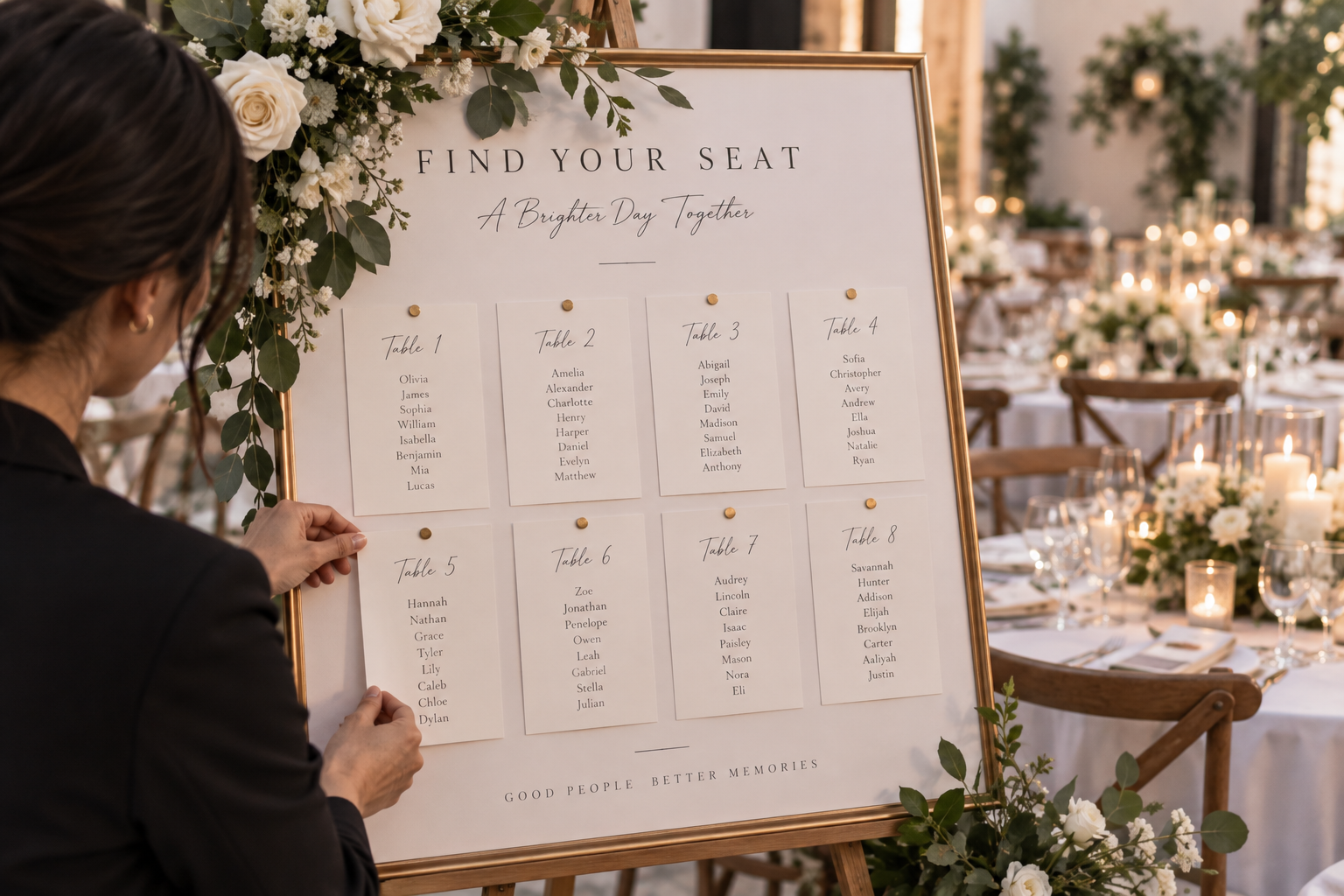
Blessing.
Cake cutting.
Another tradition.
If all of these happen before food, guests may spend a long time sitting and waiting.
There is no universal order that every wedding must follow.
Arrange formalities around the priorities of the couple, guest comfort, and catering flow.
Speeches Need Limits
A timeline might allocate fifteen minutes for speeches.
Then five people speak for eight minutes each.
The schedule is now thirty minutes behind.
Give speakers expectations beforehand.
How many people are speaking?
When?
For approximately how long?
Who introduces them?
Clear guidance helps speeches remain meaningful without accidentally taking over the reception.
Do Not Put Speeches Where Nobody Can Hear Them
Timing is only one part of the problem.
Dinner service may create noise.
Staff may be clearing plates.
Guests may be moving.
A speech scheduled during the wrong service moment can lose attention.
Coordinate with catering and entertainment so the room is ready to listen.
The schedule should account for atmosphere as well as minutes.
Protect Time for the Couple to Eat
This sounds obvious.
Yet couples sometimes finish their wedding and realize they barely touched dinner.
They greet tables.
Take photographs.
Speak with vendors.
Handle traditions.
Someone asks for another picture.
The next scheduled event arrives.
Create a real eating window.
Not theoretically.
Actually.
The couple has spent months choosing the menu. They should get to experience it.
Give the Couple a Private Five Minutes
Not every minute needs an audience.
After the ceremony or before the reception entrance, a brief private pause can be incredibly valuable.
No photographs.
No greetings.
No instructions.
Just a moment to realize:
“We’re married.”
A wedding day moves quickly.
Without intentional pauses, the couple can feel like they spent the entire event being transferred from one activity to another.
Sunset Photos Should Be Planned Around Actual Sunset
If golden-hour portraits matter, the photography timeline needs to work with natural light.
Sunset changes throughout the year and depends on location.
Do not simply copy a timeline from another wedding held in a different month.
Your photographer can help identify a practical portrait window.
Then protect it from competing activities.
Do Not Make Guests Wait for Sunset Photos Without a Plan
The couple disappears for portraits.
That can be completely fine.
But what are guests doing?
Eating?
Enjoying cocktails?
Listening to music?
Talking?
If guests have something comfortable and natural to do, they may barely notice.
If everyone is seated waiting for the couple to return before anything can begin, twenty minutes can feel much longer.
Good timelines consider both sides of every activity.
The First Dance Should Support the Energy of the Reception
Some couples prefer the first dance immediately after entering.
Others place it after dinner.
Both can work.
The better option depends on the overall flow.
Ask what happens immediately before and immediately after.
Transitions create energy.
A great moment can feel awkward if the next step requires ten minutes of confusion.
Do Not Interrupt the Dance Floor Every Ten Minutes
Once people start dancing, repeated interruptions can kill momentum.
Dance.
Stop for cake.
Dance.
Stop for another speech.
Dance.
Stop for a game.
Dance.
Stop for a photo.
Every restart requires the room to rebuild energy.
Whenever possible, group formalities thoughtfully so the open-dancing portion has enough uninterrupted time to become a real party.
Cake Cutting Does Not Need to Stop the Entire Wedding
Depending on the celebration, cake cutting can be a major formal moment or a quieter transition into dessert.
Decide how important it is to you.
If it matters, feature it.
If it does not, do not automatically interrupt the strongest part of the party simply because a generic wedding template says cake must happen at a particular time.
The timeline should reflect your priorities.
Build the Schedule Around What Matters Most
Ask the couple separately:
“What are the three moments you care about most?”
The answers reveal where time should be protected.
Maybe photography matters enormously.
Maybe dinner does.
Maybe the ceremony.
Maybe dancing.
Maybe spending time with grandparents.
Maybe the couple wants a relaxed morning.
There is no reason to give equal weight to every traditional wedding element.
A good wedding day timeline protects priorities first.
Remove Traditions You Do Not Care About
Bouquet toss.
Formal cake cutting.
Grand entrance.
Receiving line.
Parent dances.
Wedding party introductions.
None of these automatically has to happen.
Traditions should be included because they matter to the couple, family, culture, or celebration.
Not because someone found them on a checklist.
Every removed formality creates more time for something you actually value.
Cultural and Religious Traditions Need Real Time
Some weddings include multiple ceremonies, outfit changes, blessings, tea ceremonies, dances, family rituals, or other cultural elements.
Do not squeeze meaningful traditions into tiny gaps to preserve a generic reception structure.
Build the day around them.
Ask the people involved how long they realistically take.
Include preparation and transition time.
The timeline should serve the celebration rather than forcing every celebration into the same template.
Outfit Changes Need Their Own Block
A five-minute outfit change often becomes fifteen.
You need to leave the room.
Reach the changing area.
Remove one outfit.
Put on another.
Adjust hair or accessories.
Return.
If photographs are involved, it may take longer.
Treat outfit changes as real activities.
Do not hide them inside another timeline block.
Children Change Timing
Children do not operate according to production schedules.
They need food.
Bathroom breaks.
Rest.
Reassurance.
A flower child may suddenly refuse to walk.
A ring bearer may become overwhelmed.
Build flexibility around children rather than expecting perfect rehearsal behavior.
If they participate beautifully, great.
If they do something completely different, that may become one of the day’s best memories.
Older Guests Need Consideration Too
Long walks between spaces, extended standing periods, stairs, heat, and late dinners can affect older guests.
Look at the event from their perspective.
Where can they sit?
How far are transitions?
Is transportation available?
Will dinner begin at a reasonable point?
A timeline is also a hospitality tool.
Vendors Need the Same Version of the Plan
If the photographer has one timeline, catering has another, and entertainment received an older draft, problems become inevitable.
Once the schedule is finalized, distribute the current version to everyone who needs it.
Mark revisions clearly.
Confirm important arrival and setup times.
The goal is one shared understanding of the day.
A Timeline Should Say Who Is Responsible
Compare these:
“6:20 — Guests seated.”
Versus:
“6:20 — Coordinator invites guests into reception; venue staff assist with seating; DJ prepares entrance.”
The second version is operational.
People know what they are doing.
For important transitions, identify ownership.
Otherwise everyone may assume someone else is handling it.
Give Vendors Setup Time
A vendor arrival time is not the same as the time their service begins.
Musicians need setup.
DJs need sound checks.
Florists need installation time.
Catering needs preparation.
Photographers may need to scout.
Rental teams need access.
The internal timeline should distinguish arrival, setup, ready time, and service start when relevant.
Create a Separate Guest-Facing Schedule
Guests do not need the minute-by-minute production document.
They need the information that affects them.
Ceremony start.
Transportation.
Reception location.
Any significant gap.
Dress considerations.
Important departure information.
Maybe weekend activities for destination weddings.
Too much operational information can make communication harder rather than easier.
Do Not Make the Couple the Information Desk
On the wedding day, somebody will have a question.
Where does this go?
When does the shuttle leave?
Where is the boutonniere?
Has the cake arrived?
Which table is this guest at?
The answer should not require calling the couple.
Designate a planner, coordinator, trusted person, or appropriate vendor contact who can handle operational questions.
The couple should be experiencing the wedding.
Not running it.
Build a Contact Sheet
The internal plan should include important vendor contacts.
Venue.
Coordinator.
Catering.
Photography.
Entertainment.
Transportation.
Florist.
Rental company.
Other essential vendors.
If a driver is late, the person responsible should not need to search through months of messages for a phone number.
Good preparation makes problem-solving quiet.
Plan for Weather Before the Wedding Day
Outdoor weddings need a backup plan.
Not merely:
“If it rains, we’ll figure it out.”
Where does the ceremony move?
When is the decision made?
Who makes it?
What happens to chairs?
Florals?
Sound?
Guests?
Photography?
A weather plan works best when it already exists before anyone needs it.
A Backup Plan Needs Its Own Timeline
Moving a ceremony indoors may change setup time.
Vendor access.
Guest movement.
Photography locations.
Sound.
Seating.
That means Plan B may require a different sequence.
Do not assume the original timeline works perfectly after a major location change.
Prepare enough detail that the team understands how the day shifts.
Small Delays Are Normal
A wedding running seven minutes behind is not necessarily a problem.
People are not machines.
The goal is not minute-perfect performance.
The goal is protecting the major parts of the event.
If buffers exist, small delays disappear naturally.
If every block touches the next with zero margin, seven minutes can eventually become forty.
Know What Can Be Shortened
When a delay happens, the team should know what is flexible.
Maybe cocktail hour can shift slightly.
Maybe one photo combination can be skipped.
Maybe a transition can be simplified.
Maybe a formal announcement can happen during another block.
Do not make these decisions for the first time under pressure.
Identify flexible and protected moments beforehand.
Do Not Steal Time From the Couple’s Priorities First
When the schedule slips, people often cut whatever comes later.
Unfortunately, that may be the exact thing the couple cared about most.
Their sunset portraits disappear.
Dinner becomes rushed.
Dancing gets shortened.
Instead, know in advance which parts are essential.
Protect them.
A timeline is not successful simply because the wedding ends on time.
It is successful when the important experiences actually happen.
The End of the Wedding Needs Planning Too
The last dance finishes.
Then what?
Guest transportation.
Personal belongings.
Gifts.
Cards.
Decor.
Rental items.
Leftover food.
Flowers.
Wedding attire.
Vendor breakdown.
Someone needs responsibility for these things.
The couple should not reach the end of the night and discover they are suddenly in charge of packing the venue.
Plan the Send-Off Around Reality
A formal exit can look wonderful.
But think about timing.
Are most guests still present?
Is transportation ready?
Does the venue allow the planned exit material?
Does the photographer stay that late?
Does the event actually continue after the “exit”?
Sometimes a staged send-off earlier in the evening makes more sense.
Sometimes the true final exit is perfect.
Choose based on the event rather than convention.
Your Timeline Should Have Breathing Room
A wedding that feels relaxed is not necessarily loosely planned.
Often the opposite is true.
The logistics are detailed enough that the people attending do not have to think about them.
Transitions have margin.
Vendors know their roles.
Guests know where to go.
The couple is not constantly checking the clock.
The structure exists quietly underneath the experience.
That is the real purpose of planning.
Conclusion
A detailed schedule does not automatically create a relaxed wedding.
If every activity is placed back-to-back, the day may look efficient on paper while feeling rushed in reality.
A strong wedding day timeline accounts for more than ceremonies, photographs, dinner, speeches, and dancing.
It includes movement.
Setup.
Guest seating.
Getting dressed.
Vendor handoffs.
Transportation.
Food service.
Weather decisions.
And small buffers between important moments.
Start with the fixed times, then build around the couple’s real priorities. Give important transitions enough space and make sure every operational task has someone responsible for it.
Most importantly, remember what the schedule is supposed to accomplish.
The couple should not spend their wedding day thinking about whether they are seven minutes late.
They should be able to experience it.
The best timeline is not the one that packs the most into every hour.
It is the one that quietly gives everyone enough time to be where they need to be—while giving the couple enough room to actually enjoy the day they spent so long planning.